Audio Analytics: Enhancing Security and Safety with Sound Detection Systems
Security does not necessarily just be seen by the cameras. In most real-life occurrences the initial warning of danger comes not visually, it comes as sound. A scream in a parking place, screaming in a restricted corridor, breaking glass after the business has closed down, or a strange sound somewhere in a restricted passage, can all indicate that there is something that is immediately required by the business.
This is the place audio analytics comes in handy. With AI-based sound classification, an intelligent sound detection system will detect critical sound patterns in real-time and alert security teams before an incident escalates. In conjunction with video surveillance, audio security and audio safety technologies assist organizations to detect, verify and respond to events faster.
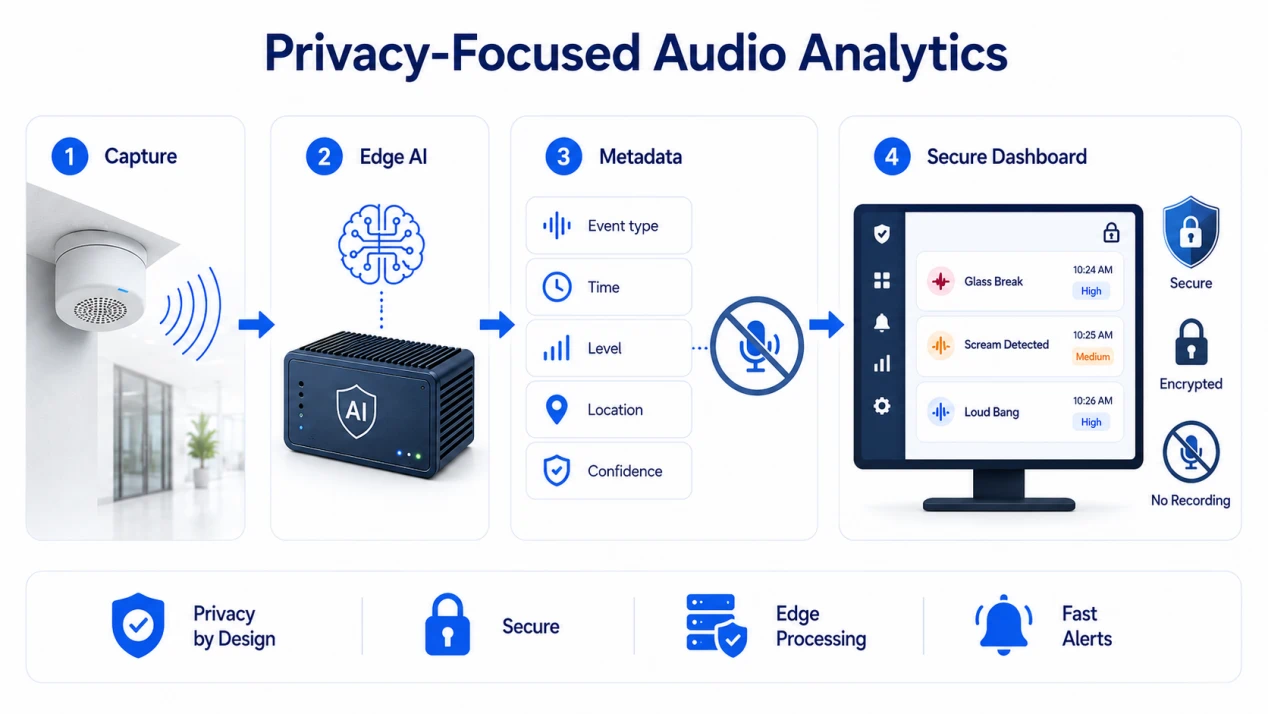
The privacy of modern acoustic monitoring solutions is also taken into consideration. Many systems do not continuously record conversations but instead analyze sound locally on the edge device and produce audio metadata, including the type of sound detected, the sound pressure level, and event traps. SPON , as an example, focuses on edge-based audio analytics which are able to detect sounds like screams, shouts, speech, and glass breaking whilst making use of metadata to support privacy-conscious deployments.
What is Audio Analytics?
Audio analytics refers to the practice of utilizing software, often based on artificial intelligence, to analyze sounds and find meaningful audio events. The system is in a way automated to identify particular patterns of sounds and provide alerts when something out of the ordinary or out of the norm happens instead of relying solely on a human operator to listen to a live audio stream.
Common Sounds Detected by Audio Analytics
- Screaming
- Shouting
- Speech presence
- Glass breaking
- Abrupt alterations of the sound levels.
- Abnormally loud noises
- Sound pressure level changes
Audio analytics is another layer of sensor in a security context. Information is provided by cameras, which give visual information and microphones or acoustic sensors that provide information in the form of sound. The combination of these two forms a more complete situational awareness system.
Why Audio Analytics Matters for Security and Safety
1. Faster Incident Detection
Most of these incidences create sound and then one can easily see on camera what is happening. Here are some examples, an argument can start as someone yells, a break-in can begin with a person screaming, and a person in distress can scream before he or she enters the field of view of a camera.The early warning signs can be detected using a sound detection system and early warnings sent to operators immediately. This assists in quicker response and in certain situations it can be used to help avoid a further escalation. SPON says it is among the most important advantages of audio analytics to security and safety: it allows early detection, quick response, and avoids escalation.
2. Improved Verification with Video Surveillance
Audio analytics can be particularly strong when used with video surveillance. A sound can automatically signal operators to the appropriate camera view which will enable operators to quickly check out what is going on.
Example Workflow:
When a scream is detected outside a door, the system automatically raises an alert and directs the operator to the camera covering that area. The operator can then review the live video, verify the situation, and decide whether action is required.By combining audio surveillance with video surveillance, the system helps operators locate and evaluate incidents more quickly, reducing response time and improving overall security efficiency.undefined
3. Enhanced Awareness in Challenging Environments
Poor lighting, blind spots and smoke, weather, crowd density or obstruction can affect video cameras. Sound is at times able to depict the events that are not detected by cameras.It does not imply that video should be substituted with audio. Rather, acoustic monitoring is most effectively used as a complimentary layer. It provides the security teams with the alternative source of the real-time information.

Key Components of an Audio Security System
A contemporary audio security system typically consists of a number of key elements.
1. Audio Input Device
This can be microphone, a camera with inbuilt audio facility or acoustic sensor. This device records the sound in the surrounding and converts them to a digital signal which is analyzed.Certain privacy-conscious acoustic sensors are created to capture sound events without permitting full audio streaming or recording.
2. Edge-Based Audio Analytics
Edge analytics refers to the fact that the analysis occurs on a device, eg, a camera or microphone, rather than sending all the raw audio to an analysis server or cloud platform.
Benefits of Edge-Based Processing:
- Lower bandwidth usage
- Faster real-time response
- Less reliance on cloud connection.
- Stronger privacy protection
- Scalability spread among multiple locations with ease.
SPON also notes real-time edge analytics as a significant aspect of privacy-conscious audio analytics since the system can process sound on-the-fly and produce metadata instead of actual audio.
3. Audio Metadata
Audio metadata is data pertaining to the sound, but is not necessarily the sound recording itself. Examples of Audio Metadata:
- Sound event type
- Detection time
- Sound pressure level
- Event duration
- Device location
- Confidence score
- Trigger status
This metadata may be utilized in alerts, dashboards, incident searches, long-term trend analysis. Since metadata does not involve embedding of the original audio stream it can enable organizations to gain security insights whilst minimizing privacy risk.
4. Event Management System
Possible Alarm Linkage:
- Alert to security personnel.
- Showing an associated camera view.
- Starting video recording
- Turning on lights or speakers.
- Logging an event
- Sending data to a dashboard or VMS
This makes the passive monitoring the active response.
Common Use Cases for Audio Analytics
Reception Areas and Banks
Audio analytics can be used in banks, at the reception desks, service counters, and similar placements, to detect evidence of distress due to shouting, screaming, aggressive behavior, or other manifestations of distress. These are environments where quickly responding is often necessary as staff safety and customer safety are of high priority.
Retail Stores and Restaurants After Hours
During non-business hours, loud noise, voice, sound of glass breaking can be an indication of unauthorized access. A sound detection system will notify the security personnel before motion is detected on camera.
Schools and Public Facilities
Whether it is in a hospital or government building, the audio safety system will be able to pick up the audio signal of a conflict, distress, or even unusual activity. Acoustic monitoring may contribute to a healthy environment regarding staff, visitors, and students as long as it is implemented in a responsible and legal manner.
Parking Areas and Stairwells
Certain areas are hard to keep an eye on due to lighting, angles or design. Audio analytics are capable of identifying abnormal sound events in these locations and assist security groups to investigate more swiftly.
Industrial Sites and Critical Infrastructure
Audio analytics can be used in the industrial setting to aid in the safety and security. The loud abnormal sounds, abrupt impact sounds or alteration of acoustic patterns can assist the operators to locate problems at an early stage.
Audio Safety & Audio Security
What is Audio Safety?
Audio safety is concerned with the safety of people. This can involve hearing screams, calls or cry of help, aggressive screams or sound levels that are abnormal which may depict an emergency.
What is Audio Security?
Audio security is concerned with the safeguarding of property, facilities and restricted sites. This may involve glass breaking, unauthorized presence, intrusion related sound or suspicious activity after hours.Practically, both can be achieved by the same audio analytics platform.
Privacy Considerations for Audio Surveillance
Why Privacy-by-Design Matters
There is a risk of audio surveillance raising privacy concerns particularly when individuals are concerned about whether or not they are being recorded. It is due to this reason that privacy-by-design is necessary.
Key Privacy Questions to Address:
Whether audio streaming is requiring or not.
- Is audio streaming required?
- Is audio recording enabled or disabled?
- Who has access to audio features?
- Is only metadata stored?
- What local laws and workplace policies apply?
- Is there a clear signage?
- What are the data retention settings?
- Are audit logs and access controls in place?
SPON notes that the devices it manufactures have audio stream and audio recording disabled by default, and that audio analytics can be executed by metadata, without the need to continuously stream audio.This is essential since organizations may sometimes have the advantage of sound based alerts without having to archive sensitive dialogues.
Benefits of Audio Analytics for Organizations
Faster Response
The security teams are able to be alerted immediately a critical sound event takes place.
Reduced Operator Workload
As an alternative to checking various feeds all the time, operators are able to concentrate on confirmed feeds.
Better Incident Search
Audio metadata may enable easier search through events in recorded systems, eg when glass was breaking or when someone was shouting.
More Complete Situational Awareness
Sound is another intelligence element to visual surveillance.
Privacy-Friendly Monitoring
Designed in the right way, systems can analyze sound locally, and use metadata in place of raw audio.
Scalable Security Operations
The audio analytics that uses edges can consume less bandwidth, less server load, hence it can be easily deployed in various locations.
Challenges and Limitations of Audio Analytics
Audio analytics is interesting, but not flawless. The limitations of this should be known to an organization prior to implementation.
Background Noise
Detection accuracy can be influenced by rain, thunder, sirens, music, machinery or crowd noise.
False Alarms
There are other types of sounds that can be similar to the target events. To illustrate, high music or construction noises can pass off as shouting or breaking glass.
Environment Tuning
The acoustic profile of different locations is different. An office in a quiet environment, a busy restaurant, and an industrial place demand different requirements and conditions.
Legal Compliance
The laws of audio monitoring also depend on the country, state and the workplace environment. It is always advisable that organizations confirm any local legal requirements before allowing audio surveillance or recording.
Best Practices for Implementing a Sound Detection System
Define the Goal First
Prior to implementing audio analytics, determine what you wish to identify. For example:
- Shouting in the street.
- Hourly glass breaking.
- Unusual noises in confined areas.
- Presence of speech close to sensitive areas.
- High levels of sound pressure in work areas.
Having clear goals can prevent unwarranted monitoring.
Combine Audio with Video
Trigger attention with the help of audio analytics, and confirm the event with the help of video. This develops a more robust and dependable security workflow.
Use Edge Analytics Where Possible
By keeping the raw audio local, edge processing can enhance quicker reply, less bandwidth waste, and promote privacy.
Store Metadata Instead of Raw Audio Where Appropriate
In most applications, event metadata can be stored. This is able to minimize privacy and compliance risks.
Test in Real-World Conditions
The sound detection system needs to be tried in the real world in which it will be utilized. Background noise, room acoustics may influence performance.
Check Privacy and Legal Requirements
Prior to authorizing audio surveillance, consult the relevant laws, policies and compliance teams.
The Future of the Audio Analytics in Security and Safety.
The future of audio analytics in security and safety may be the smarter AI models, improved event classification, enhanced privacy controls, and more integration with the video management systems.Organizations can gradually transition off basic noise detection and to more sophisticated acoustic intelligence as audio analytics becomes more precise. This can comprise trend analysis, predictive safety warnings, and automated incident workflows.Nevertheless, those deployments, which will balance the value of security and responsible practices in privacy, will be most successful.
Conclusion
The concept of audio analytics is turning into a significant component of modern security and safety systems. A sound detection system can assist organizations react quicker and enhance situational awareness by detecting critical sounds such as screams, shouts, speech, glass breaking, and sudden change in sound.Audio security when used together with video surveillance, forms a more effective method in identifying and validating incidents. Acoustic monitoring also can be used to support privacy-conscious operations when implemented with edge processing and metadata-based analysis.Audio analytics provides a viable and potent step farther to other organizations wishing to enhance their audio safety and reduce response time, as well as to strengthen their security infrastructure.

FAQS
Q1: What is audio analytics in security systems? 

Audio analytics is an AI-based technology that analyzes sound patterns in real time to detect important audio events, such as screams, shouting, glass breaking, abnormal noise, or sudden sound level changes. It helps security teams identify incidents faster without relying only on video surveillance.
Q2: Can audio analytics work together with video surveillance?
Yes. Audio analytics can trigger an alert when a critical sound is detected and automatically direct the operator to the related camera view. This helps operators locate, verify, and respond to incidents more quickly. SPON has a series of surveillance microphone which can semelessly work with CCTV/NVR system.
Q3: Does audio analytics require continuous audio recording?
Not always. Privacy-conscious audio analytics systems can process sound locally on edge devices and generate metadata, such as sound type, detection time, sound pressure level, and event status, instead of continuously recording conversations. This helps improve security while reducing privacy risks.



 2026-05-09
 Author: Tim
 Page view: 1113



 AR
AR
 EN
EN


