


 2025-07-07
 Author: cora
 Page view: 1036
Audio interfaces are used to connect microphones and other sound source devices, serving as a bridge between the analog and digital worlds. In this blog, we will learn about the functions, types, and common audio cables of audio interfaces.
What is an audio interface?
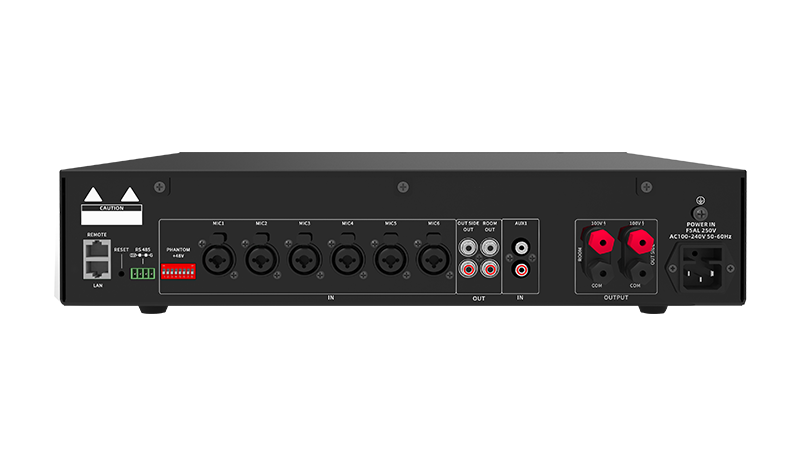
An audio interface is a device specifically used to connect audio devices to computers. Its main function is to realize the input and output of sound signals and convert between analog signals and digital signals. Simply put, an audio interface is a "bridge" for sound, allowing microphones, musical instruments, players and other sound source devices to be recognized and processed by the computer, while also allowing the sound in the computer to be clearly transmitted to external devices, such as amplifiers or speakers.
What does an audio interface do?
Audio interfaces are a key component of any audio system. They are the rows of ports or jacks on the back or front of the device. These ports are used to connect different audio devices and convert sound signals from one type to another. Through these jacks, we can connect microphones, musical instruments, music players, speakers, and more. This allows the sound to be transmitted in the system in the correct manner for clear and smooth playback.
1. Signal conversion
One of the most important functions of the audio interface is signal conversion. In reality, sound exists in the form of analog signals, that is, waveforms in which voltage changes continuously over time. But many modern devices, including computers, digital mixers, network audio systems, etc., can only process digital signals, that is, binary data composed of "0" and "1". In order for these devices to understand the sound, the audio interface will first perform analog-to-digital conversion to convert the analog signal into a digital signal. This process is called analog-to-digital conversion (ADC). When we speak, the microphone converts the sound into an analog electrical signal, and the audio interface then converts this electrical signal into digital data through steps such as sampling and encoding for the system to process. When the device needs to output sound, such as playing music or voice, the audio interface will perform digital-to-analog conversion, that is, DAC, to restore the digital signal to an analog electrical signal, and then send it to the power amplifier or speaker, so that we can finally hear the sound. It can be said that the audio interface is like a two-way translator, helping the analog and digital worlds to communicate freely.
2. Signal routing
In addition to converting signals, the audio interface is also responsible for arranging the flow direction of the sound signal, which is the function of signal routing. In a complete audio system, the sound signal often needs to go through multiple processing links, such as from the microphone into the preamplifier, then sent to the analog-to-digital converter, and then transmitted to the computer or digital control system. These transmission paths are not fixed, but can be flexibly configured according to different applications. The audio interface assumes the role of this "traffic commander" to ensure that each signal can flow in the correct order. In a digital audio system, users can also set up logical routing to allow the sound signal to be output from a certain software channel, then transmitted to the hardware effector for processing, and finally sent to the monitor speaker for monitoring. This flexible signal path setting enables the audio interface to not only cope with simple input and output, but also meet complex recording, mixing, broadcasting and other needs. Some high-performance audio interfaces even support multi-channel parallel transmission, audio mixing matrix, and real-time bypass operation, which greatly improves the system's adaptability and work efficiency.
3. Connection Adaptation
The last important function is to connect and adapt different types of audio devices. In reality, different devices use different audio interface types, voltage standards, and impedance characteristics. The audio interface needs to have good compatibility to ensure normal operation between various devices. Common physical interface types include XLR, TRS, TS, and RCA.
In order to further ensure compatibility and sound quality, the audio interface will also perform some technical processing on the signal itself. For example, when connecting high-impedance devices such as guitars, the interface will provide a Hi-Z input channel so that the signal can be correctly input without distortion. For devices such as microphones with very weak signals, the interface will increase the level through a preamplifier to reach the working range required by the system. In short, the audio interface is a bridge between audio devices, signal conversion, and system adaptation.
Types of audio interfaces
Audio signal interfaces can be divided into analog audio interfaces and digital audio interfaces according to the type of transmitted signals; they can be divided into balanced interfaces and unbalanced interfaces according to the wiring method.
Analog audio interface: Analog audio is a technology for transmitting, recording, replaying and processing sound signals in an analog state. Similar to the megaphone game in daily life, the transmission of analog audio interfaces is intuitive and easy to implement, but it is relatively distorted and unstable. Common analog audio interfaces are TRS interfaces, XLR cannon heads, and RCA lotus heads.
Digital audio interface: Digital audio is a technology for recording, storing, editing, compressing or playing sound by digital means. The transmission of digital audio signals requires sampling the analog signal first, then quantizing the sampled values into different levels, and then encoding the different quantized levels. One level corresponds to a group of binary digits, and finally a series of binary digits are obtained, completing the conversion of analog signals to digital signals. Therefore, the higher the sampling rate and quantization level, the higher the accuracy of analog-to-digital conversion, and the stronger the ability to restore the signal. Common digital audio interfaces are AES/EBU physical interface, S/PDIF interface, coaxial interface and optical fiber interface.
Balanced interface and unbalanced interface
The balanced transmission interface uses two channels to transmit signals with the same voltage but opposite phases. The receiving device subtracts the two sets of signals, and the interference signal is offset, thereby obtaining a high-quality analog signal. Common balanced transmission audio interfaces are TRS interfaces and XLR cannon heads.
The unbalanced transmission interface is composed of a signal line responsible for transmitting the signal and a ground line. During the transmission process of the signal, the wire will be interfered by the outside world and amplified by the microphone amplifier or power amplifier. Due to its weak anti-noise ability, it is easy to output a noisy sound. Common unbalanced transmission audio interfaces are TS interfaces and RCA lotus heads.
Common audio interfaces
1.TRS
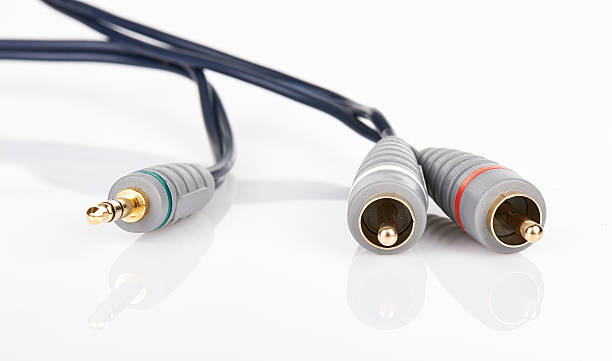
TRS is like an ordinary headphone plug. Its full name is Tip-Ring-Sleeve. There are usually three metal segments on the plug, corresponding to the left channel, right channel and ground wire. It can transmit stereo audio signals or balanced mono signals. It is wear-resistant and suitable for repeated plugging and unplugging. It can well suppress noise interference within a certain distance. Common ones are 6.35mm and 3.5mm.

2.TS
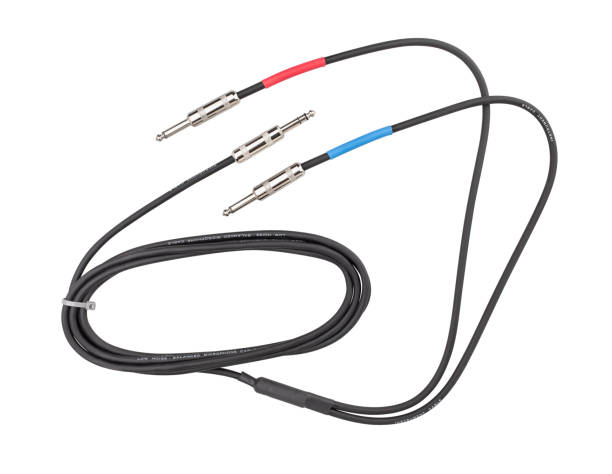
The TS interface is similar to TRS in appearance, but it has only two metal segments, one is the signal end and the other is the ground wire, and cannot transmit balanced signals. It is more commonly used for unbalanced audio connections, such as connecting electric guitars, electric basses or other instruments to speakers or mixers. This interface has a simple structure, but its anti-interference ability is weak, and it is usually only suitable for short-distance use.
3.XLR
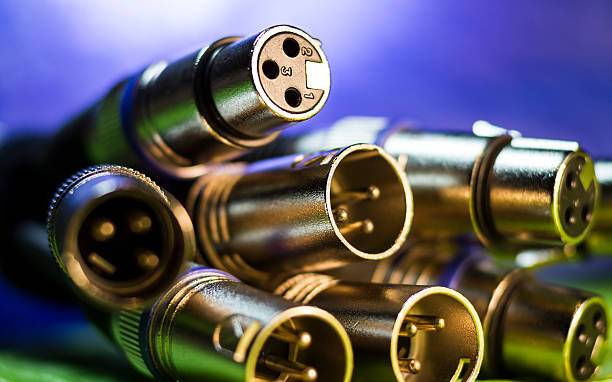
The XLR interface is a professional-grade audio interface consisting of a three-pin plug (male port) and a locking device (female port). It can transmit balanced audio signals and is the most commonly used interface type for professional microphones. The design of the XLR interface is very stable. It is locked with a buckle after insertion and is not easy to loosen. It can effectively suppress external interference and keep the sound quality clear and stable even in long-distance transmission. In stage sound reinforcement, broadcasting systems and recording studios, XLR is a very common standard interface.
4.RCA
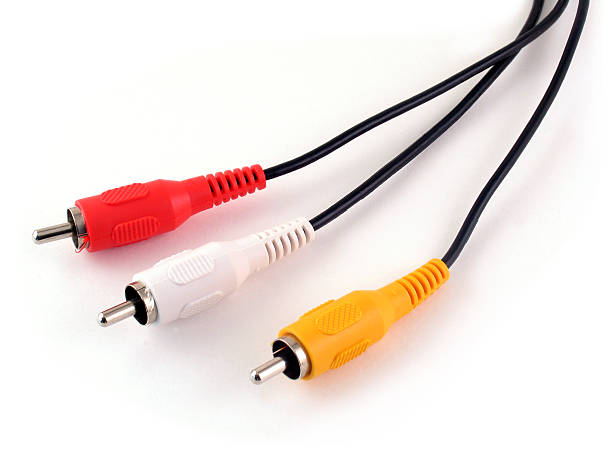
RCA interface is an audio interface widely used in home audio equipment. The plug is a round metal pin, usually with color markings, red for the right channel, and white or black for the left channel. The RCA interface transmits unbalanced analog audio signals, with a simple structure and low manufacturing cost, but poor anti-interference ability, suitable for use in short-distance home environments. Many old DVD players, TVs and amplifiers have this interface.
5.S/PDIF-RCA
Although the S/PDIF-RCA interface looks like an ordinary RCA plug, it transmits digital audio signals. This interface is often used to send digital audio from a playback device to an amplifier or audio processor, such as from a CD player to a home theater system. Because it is digitally transmitted, it can maintain the integrity of the audio signal and support high-fidelity audio quality.
6.BNC
The BNC interface is mainly used in professional broadcasting and video systems, but it is also used to transmit digital audio signals or clock signals in some high-end audio applications. Its structure has a rotating lock, and the connection is very stable and not easy to loosen. Unlike the RCA interface, BNC is usually used in higher frequency and higher stability transmission environments, such as digital audio synchronization signals.

7.OPTICAL
The OPTICAL interface, also known as the optical fiber interface, uses optical signals instead of electrical signals to transmit digital audio. The biggest advantage of optical fiber transmission is that there is no electromagnetic interference at all, so clear sound quality can be maintained even in high-interference environments. Optical fiber interfaces are commonly used in digital audio transmission between devices such as home theaters, game consoles or TVs. It can support surround sound systems such as Dolby Digital or DTS.
8.MIDI
The MIDI interface, unlike the previous ones, does not directly transmit sound, but transmits music control information. MIDI stands for Musical Instrument Digital Interface. It allows different electronic instruments, computer software, and sequencers to communicate with each other, such as allowing a keyboard to control another synthesizer, or controlling percussion equipment by writing music on a computer. Although MIDI does not transmit sound, it is a very important tool in music creation and performance.
Conclusion
In this blog, we introduce the relevant knowledge of audio interface. Audio interface is an important channel for sound input and output, which can be connected to microphone, amplifier and speaker. According to the type of transmission signal, it can be divided into analog audio interface and digital audio interface. According to the wiring method, it can be divided into balanced interface and unbalanced interface. Common interface types are TRS, TS, XLR and RAC. If you don't know how to choose the right audio cable for your project, you can contact us. We have a professional technical team to help you.


 AR
AR
 EN
EN


