


 2025-10-10
 Author: Tim
 Page view: 2719
The successful installation of a professional public address (PA) or audio system is a matter of precision. The difference between a crystal-clear, reliable system and one plagued by hum, distortion, and instability lies in the details. A truly effective installation relies not just on quality equipment, but on a deep understanding of its two foundational pillars: physical cabling and network infrastructure.
Designed for installers, project managers, and technicians, this pre-installation manual covers these fundamentals. By mastering these core principles, you will avoid common pitfalls and be equipped to deliver a professional and reliable outcome on every project.
The Physical Foundation – Mastering Audio Cables and Connections
Any signal sent before the transmission of a single signal has to travel via a physical medium. Best and type of cabling and connections that you establish is the first element that can be used to maintain audio integrity.
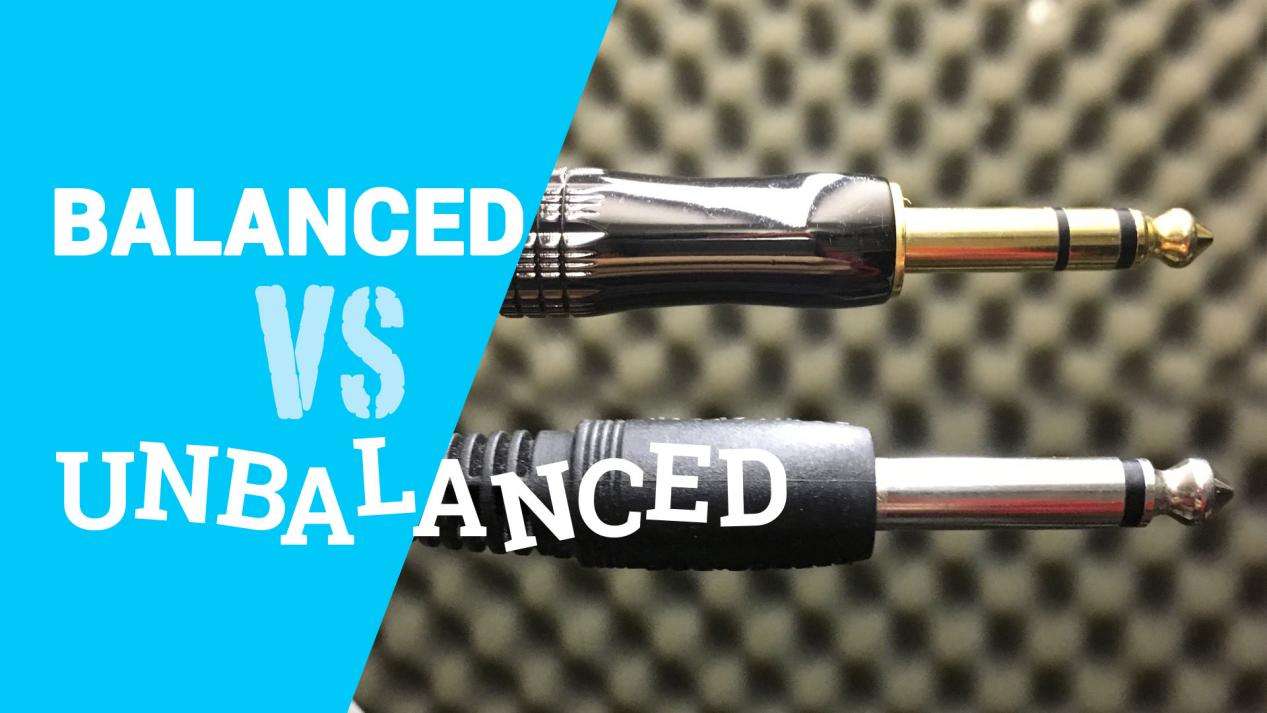
1.Balanced vs. Unbalanced: The Core of Signal Integrity
The distinction between balanced and unbalanced signals would be the most significant information in professional audio cabling. This is a potentially direct indigenous to your system to be exposed to noise.
♦ Imbalanced Cables (The Short-Distance Option)
Unbalanced cable consists of two cables: one of them is a signal conductor, and the other one is the ground conductor. The ground wire is a reference where the signal is known to work, however, the signal also works as an antenna where it collects the electromagnetic interference (EMI) and radio frequency interference (RFI) of power cables, lights and other sources close enough to them. This noise is inserted with the audio signal and is amplified together with it creating audible hum or buzz.
♦ Common Connectors:
RCA (Phono): The consumer grade equipment standard of home stereo. They are usually color coded red to the right hand side and white or black to the left hand side.
TS ( Tip-Sleeve): This type is a connector with a diameter of 6.35mm (1/4$). It is the choice when a connection with electric guitar or keyboard needs to be made. The tip fastens the signal and the sleeve the ground.
Optimal: The limitation of noise to unbalanced cables is too high, particularly at short distances of less than 10 meters (approximately 30 feet) of run.
♦ Balanced Cables (Professional Standard)
Balanced cable consists of three wires of which two are signal wires and the third is a special ground. It operates on the principle of trying to transmit two copies of the audio signal in a pair of signal wires, the normal polarity (the hot one) of which signal is called the hot end signal and the other of which is known as the cold end signal the latter being constructed of the same material as the first.
At the destination of the signal sending end, the signal which was aftrichained is flipped back to the normal signal by the receiving device. The smart one then becomes that any noise that is received in the cable will be equally felt on the hot and cold wires. Inversion in noise is also inverted when the polarity of the cold signal is reversed. Cancelling out The two noise signals are now out of phase, and they cancel out to zero- again, termed as Common Mode Rejection.
♦ Common Connectors:
XLR (Cannon): This is the unquestioned professional audio standard. These heavy connectors cannot be removed by any other method except by the unlocked connector making them useful in the microphones, mixers, amplifiers, and almost all high end equipment. They become vital in transferring the much lower level signals of microphones and provide the +48V amount of phantom power to the condenser micas.
TRS ( Tip- Ring-Sleeve): This connector resembles a TS connector but the plug has an additional prong called a ring which as a result, provides three points of contact. This enables it to support a balanced mono signal (Tip=Hot, Ring=Cold, Sleeve=Ground) or an unbalanced stereo signal ( Tip=Left, Ring=Right, Sleeve=Ground).
Best Use Case In any professional application, particularly sports and networking of microphone and long cable scenarios, where noise rejection is essential.
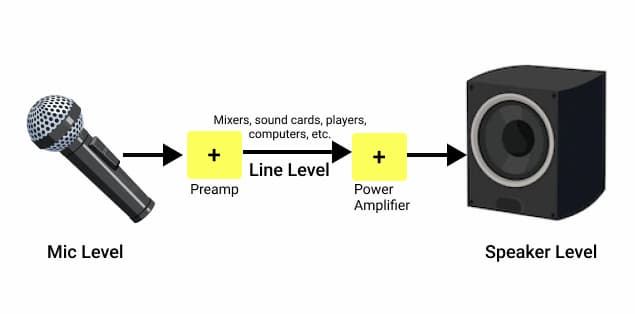
2. Signal Levels: Mic In vs. Line In
Mismatched signal levels are a common source of audio problems. It's crucial to understand the difference between a "Mic In" and a "Line In" port.
| Feature | Mic In (Microphone Input) | Line In (Line-level Input) |
| Signal Strength | Extremely weak (low level) | Strong (high level) |
| Core Function | To amplify a very weak signal | To transmit an already strong signal |
| Internal Circuitry | Contains a preamplifier (preamp) | No significant amplification |
| Typical Sources | Microphones | Mixers, smartphones, audio players, keyboards |
The problem is that when a line-level source (such as mixer out) is connected a line input port it will overload the preamp and create an obnoxious and harsh distortion. On the other hand, when the microphone is simply plugged into a LIn port, the signal generated would be too small to be of any use. Always ensure that you have the right source to right input.
3. Wiring Your Speakers Correctly
The last connection physically is that between the amplifier and the speakers. This uses a variant of cable and a variant of wiring method than at signal level.
Selecting the correct Speaker Cable.
A signal on speaker cables has a significantly higher power than a mic cable or line cable. The thickest part of the wire which is the thickness or gauge (measured in AWG in the United States of America, cross-sectional area in mm2 in other countries) is the most important. With a larger cross section, the resistance decreases and hence the wires can provide power at a better distance.
A reliable formula for calculating the required cross-sectional area (S) for 100V constant-voltage systems is:
S (mm²) ≈ 5 × L (km) × P (kW)
S: Cross-sectional area of the copper wire in mm².
L: Distance from the amplifier to the furthest speaker in kilometers.
P: The sum of the rated power of all speakers on the line in kilowatts.
Example: If the total speaker power is 500W (0.5 kW) and the furthest speaker is 1000m (1.0 km) away, the calculation is: S ≈ 5 × 1.0 × 0.5 = 2.5mm². You would need a speaker cable with a cross-sectional area of at least 2.5mm².
Constant-Voltage vs. Constant-Impedance Systems
Constant-Voltage (70 V/100 V): This set is used with most large-scale PA systems (e.g., in schools, retail stores, and airports). It enables cable to be run long distances and many speakers can be easily connected. Of key importance is that a constant-voltage speakers are always required to be wired in parallel.
Constant-Impedance (Low-Z): This technology (4, 8, or 16-ohmand speakers) is designed whereby high audio fidelity is of the topmost priority such as in concert theaters, recording studios, and home theaters. Wiring is even more so complicated since the total impedance should be strictly adjusted to the output of the amplifier.
The Network Backbone – Essentials for Modern IP Audio Systems
The change in PA industry has been to a complete shift of IP based systems towards analog systems. The backbone of the system is the current network and it provides unmatched flexibility, scalability and control.
1. Core Network Devices in an IP PA System
A constant IP audio system depends upon the usual networking equipment.
The Traffic Hub Network Switch (The Traffic Hub).
The switch serves as the center of connections to all the devices in the Local Area Network (LAN) that are IP-based such as the main server, IPS speakers, IP-based paging microphones, and other ports of connection.
In the case of IP audio, Power over Ethernet (PoE) should be considered as the most crucial aspect that is to be found in a switch. PoE technology is used to transfer data and electric power to an apparatus with one Ethernet wire. This is a breakthrough to installations because it:
Eases Wiring: requires no individual power cable to each IP speaker or microphone.
Economy of Scale: Wastage of electrical materials and expertise.
Increases Flexibility: Devices can be made anywhere a network jack can be installed even without being close to a power jack.
The Router (The Guidepost)
It is the work of a router to interconnect networks. In something basic and single networked a router might not be essential at all. Nonetheless, it is necessary when:
Linking one subnet to another within a large campus or a Virtual LAN(VLAN).
Getting various physical locations on the internet and establishing a centralized managing broadcast medium.
2. Key Network Protocols – The "Languages" of IP Audio
The protocols refer to a set structure of rules by which the communication happens between devices. There are some basic ones in IP audio.
TCP/IP: These are the basic protocols upon which internet communication is established. TCP is a connection-oriented known to be reliable protocol (akin to a registered letter) whereas UDP is connectionless and fast (akin to a normal postcard). Latency Due to the importance given to speed, real-time audio and video streaming can frequently rely on UDP.
SIP (Session Initiation Protocol) / VoIP (Voice over IP): These are good technologies which make the network audio possible. A VoIP network is the abbreviated name that is used to describe the transfer of voice over an IP network. The special protocol is SIP which is the switchboard operator of VoIP communications. This is the one that initiates, manages, and ends a session either it be a two way intercom conversation or a zone page or a background music stream. Documenting a system on the standard SIP protocol implies a high degree of integration with the large spectrum of third-party devices.
Conclusion: Plan First, Install with Confidence
When the power is turned on is long after the quality of a professionally audio installation is determined. It is stricted during the base decisions which are made at the planning stage.
The main pillars of a successful project, such as the right choice of used cables, keeping in terms signal level difference with each other, wiring the speakers in the main system type, and creating a strong and effectively prepared network support help you be ready to succeed. Thinking ahead (planning) is the best weapon you ever have in the bag that will save you on time, save you money and never head to the trouble shooting area in the future.


 AR
AR
 EN
EN


