


 2025-04-03
 Author: cora
 Page view: 12649
A loudspeaker makes sound by using two magnetic fields to shake a paper membrane. It’s like waving a piece of cardboard quickly in the air—you can hear the “whooshing” sound. This simple action is the key to how speakers create sound. In this blog, we’ll explore how speakers work together!
How a Loudspeaker Makes Sound
Speakers make sound by using magnetism and electric current to move air, creating sound waves.
Inside a speaker, there is a strong magnet that stays in place. A coil of wire, called the voice coil, sits in a small gap near this magnet and is attached to a thin surface called the diaphragm. When an audio signal is sent to the speaker, electricity flows through the voice coil. This creates a magnetic field, turning the coil into a temporary magnet.
Since the audio signal is always changing, the voice coil’s magnetism changes too. This makes it push and pull against the fixed magnet. As a result, the voice coil moves back and forth, carrying the diaphragm with it.
The diaphragm’s movement pushes the air, making areas of high and low air pressure—these are sound waves. When these waves reach our ears, we hear sound.
The speed of the voice coil’s movement depends on the audio signal. A fast-moving coil creates high-pitched sounds, while a slow-moving coil makes low-pitched sounds.
In short, electricity creates a magnetic force, which moves the voice coil, which moves the diaphragm, which moves the air—turning electrical signals into sound.
Parts of the Speaker
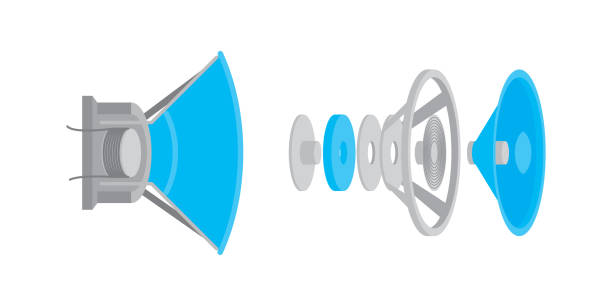
The core structure of a loudspeaker consists of a number of parts, each of which plays an important role in the production of sound.
1. Magnet
All speakers contain a magnet, either a permanent magnet or an electromagnet. The function of the magnet is to form a stable magnetic field, leaving a circular gap in the field for the voice coil and diaphragm to move through. The electromagnetic field generated when the voice coil is energized interacts with the magnet's magnetic field to drive the voice coil to vibrate, which in turn drives the diaphragm to produce sound. The strength and material of the magnet directly affects the efficiency and sound quality of the speaker.
2. Voice Coil
The voice coil is a cylindrical coil of thin copper or aluminum wire suspended between the poles of the speaker magnet. The voice coil is placed in a magnetic gap. When current flows through the voice coil, it generates a magnetic field based on the principle of electromagnetic induction, which interacts with the fixed magnetic field of the loudspeaker magnet to create attractive and repulsive forces. This force causes the voice coil to vibrate back and forth within the magnetic gap, while driving the diaphragm to vibrate in synchronization, ultimately pushing the air to form sound waves. The diameter, number of turns, and material of the voice coil affect the sound quality, sensitivity, and power handling of the speaker.
3. Diaphragm
Diaphragm is a lightweight conical membrane, usually made of paper, plastic, metal or composite materials. Its function is to convert the vibration of the voice coil into air vibration (sound waves), so that the sound spread to the outside world.
When the voice coil vibrates, it pushes the air to create air pressure fluctuations, which are further amplified by the diaphragm and spread outward, eventually being picked up by our ears. The material and shape of the diaphragm have a significant effect on the clarity, frequency response and distortion of the sound.
♦ Harder materials (e.g. metal, ceramic) help to minimize high frequency distortion and improve resolution.
♦ Softer materials (e.g., paper, composite fibers) are better suited to provide a warm, natural tone.
The structural design of the diaphragm determines the speaker's performance in different frequency ranges, so different types of speakers use different diaphragm materials.
4. Spider
Spider is a wavy, flexible material located underneath the voice coil, usually made of cloth or composite fibers. Its role is to allow the voice coil in the vertical direction to stabilize the movement, while providing the appropriate rebound force to ensure that the voice coil can follow the audio signal vibration.
5. Surround
Surround is a ring of elastic material around the periphery of the diaphragm, usually made of rubber, foam or fabric. It allows the diaphragm to vibrate freely while limiting its range of motion to prevent deformation or damage.
6. Frame / Basket
The frame is a part of the speaker's enclosure that holds and supports the internal components. It is usually made of metal or high-strength plastic, to ensure that the speaker structure is stable and not affected by the external environment.
7. Dust Cap
The dust cap is located in the center of the diaphragm and is usually a raised circular cap. Its function is to prevent dust from entering between the voice coil and the diaphragm, while enhancing the high frequency response to a certain extent.
How Speakers Create Different Sounds
Speakers can play many types of music and sounds. They work by changing electrical signals into vibrations, which create sound waves. The process happens in these steps:

1. Electrical Signal Input
A sound source (like a phone, computer, or amplifier) turns music or voice into an electrical signal. This signal is an alternating current that keeps changing. These changes control the pitch, loudness, and tone of the sound.
2. Creating Vibrations
When the electrical signal enters the voice coil, it creates a magnetic force. This makes the voice coil move, which shakes the diaphragm and pushes the air. Different signals make the voice coil move in different ways:
Different frequencies → Different pitches
• High-frequency signals make the voice coil vibrate fast, creating high sounds (like a violin or bird song).
• Low-frequency signals make the voice coil vibrate slowly, creating deep sounds (like drums or thunder).
Different amplitudes → Different volumes
• A strong current makes a strong magnet, which moves the voice coil more and creates a louder sound.
• A weak current makes a weaker magnet, which moves the voice coil less and creates a softer sound.
Different waveforms → Different tones
• A smooth sine wave makes a soft, clear sound (like a flute).
• A complex wave (with mixed frequencies) makes rich tones (like a human voice or piano).
3. Sound Waves Travel Through the Air
As the diaphragm moves in different ways, it pushes the air to create various sound waves. This is how speakers produce different types of music, instruments, and voices instead of just a simple "hum."
Electrical signals control how fast, how strong, and in what way the voice coil moves. This decides the pitch, volume, and tone of the sound, allowing speakers to play all kinds of audio.
How do speakers amplify sound?
In broadcasting, meetings, speeches and other scenarios, we often need to amplify sound so that more people can hear it. The key to amplifying sound in a loudspeaker is that the amplifier provides more current to drive the voice coil to produce vibrations of greater amplitude, which drives the diaphragm to push more air, ultimately creating stronger sound waves, allowing sound to travel farther and louder.
1. Signal Amplification
Sound signals (such as microphone sound or radio signals) are very weak. In order for a speaker to produce a louder sound, these signals are first amplified by an amplifier (power amplifier) to increase the strength of the signal.
2. Driving the voice coil to vibrate
The amplified electrical signal enters the voice coil of the speaker. The voice coil vibrates in a magnetic field and moves back and forth according to the current. The stronger the current, the greater the vibration of the voice coil.
3. Drive the diaphragm
The voice coil is connected to the diaphragm of the speaker, and when the voice coil vibrates, the diaphragm vibrates with it. When the voice coil vibrates, the diaphragm vibrates with it. The vibration of the diaphragm pushes more air.
4. Producing a louder sound
The air pushed by the diaphragm creates sound waves, which are transmitted to our ears. When the signal is amplified, the voice coil vibrates more, pushing more air, and the sound becomes louder.

Types of Speaker Enclosures
Speakers come in many designs, each with unique features that suit different needs.
Bass Reflex (Ported) Enclosure
This is one of the most common speaker designs. It uses a special opening (called a port) to let sound waves from inside the box escape. The size and shape of the port affect the deep bass sound. This design makes bass stronger, but if not done right, it can cause distortion.
Sealed Enclosure
A sealed speaker has no ports or openings. It keeps air trapped inside, which helps control vibrations for a cleaner sound. However, it requires more power to produce strong bass. This design is great for clear and tight sound, especially in high-quality audio systems.
Passive Radiator Enclosure
This design adds an extra, non-powered speaker cone (called a passive radiator) to help boost bass. When the main speaker moves, the passive radiator reacts to increase low-frequency sounds. It improves deep bass but may not respond as quickly as other designs.
Isobaric Enclosure
This type of speaker uses two drivers (speakers) working together to create stronger bass. They are usually placed face-to-face or in a special arrangement to increase low-frequency output. However, if not carefully designed, the sound may become unbalanced.
Transmission Line Enclosure
This design uses a long internal tube to guide sound waves and extend bass response. The longer the tube, the deeper the bass. However, this can also slow down the bass response, making it less suitable for fast, punchy sounds.
Horn Enclosure
Horn speakers use a flared shape to amplify sound and send it farther. They are often used in concerts and outdoor events because they can project sound over long distances. However, they are not the best for deep bass.
Loaded Horn Enclosure
This combines a transmission tube with a horn shape to improve bass response while still projecting sound far. It is ideal for large, high-energy audio systems that need powerful, far-reaching sound.
Compression Enclosure
This design places two speaker cones facing each other to push air and create deeper bass. The sound is released through tubes or openings. It can produce strong low-frequency sounds, but the design must be precise to avoid sound imbalances.
Each speaker design has its own strengths. Some focus on deep bass, others on clear sound, and some on long-distance projection. Choosing the right design helps create the perfect sound system for any need.
Conclusion
Speakers convert electrical signals into sound through electromagnetic induction and magnetic field interaction. Different frequencies determine the pitch, while different amplitudes affect the volume. A power amplifier boosts the signal, making the sound louder and clearer, enhancing the overall audio quality.
FAQ
1.Why do speakers have magnets?
Speakers have magnets to create a magnetic field that interacts with the electrical signal, causing the speaker cone to move and produce sound.
2.How fast does a speaker vibrate?
A speaker vibrates at a frequency matching the sound it produces, typically ranging from 20 Hz (low bass) to 20,000 Hz (high treble) for human hearing.
3.How do wireless speakers work?
Wireless speakers receive digital audio signals via Bluetooth, Wi-Fi, or RF, convert them into analog signals, amplify them, and drive the speaker diaphragm to produce sound.
4.How do ohms work with speakers?
Ohms measure a speaker’s electrical impedance, indicating resistance to current flow; lower ohms draw more power, while higher ohms require less but may reduce volume.


 AR
AR
 EN
EN


