


 2024-11-20
 Author: SPON COMM
 Page view: 2054
Introduction
As the demand in the audio market continues to evolve, the design and architecture of audio amplifiers have made significant advancements. When selecting the best audio amplifier IC for a specific application, it is crucial to understand the available types of audio amplifiers and their characteristics.
An audio amplifier increases the amplitude of a small signal to a useful level while preserving the details of the original signal, a feature known as linearity. The better the amplifier's linearity, the more accurately the output signal represents the input signal. As the demand for amplifier performance continues to change in the audio market, significant improvements have been made in the circuitry of audio amplifiers. In this article, we introduce the most important features of various audio amplifiers available today: Class A, Class B, Class AB, Class D, Class G, and Class DG.
Classification
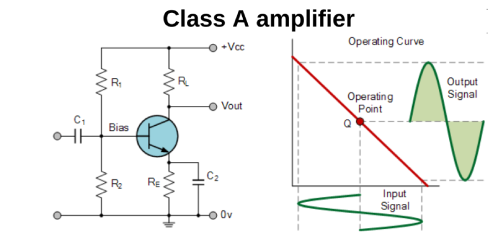
1、Class A Amplifier: The best linearity, but lower efficiency, suitable for applications that require high linearity and have low power demands.
The simplest audio amplifier is the Class A amplifier. A Class A amplifier has output transistors that are always conducting (as shown in Figure 1), regardless of the output signal waveform. Class A audio amplifiers provide the best linearity but have lower efficiency. These amplifiers are used in applications that require high linearity and where the available power is sufficient to meet the requirements.
Figure 1. Class A audio amplifiers typically offer high linearity but lower efficiency.
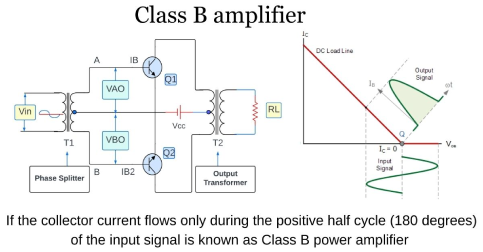
2、Class B Amplifiers: Efficiency is improved, but audio quality declines due to crossover distortion, making them unsuitable for low-power applications.
Class B Amplifiers use a push-pull amplifier configuration. The output of a Class B amplifier employs both positive and negative transistors. To reproduce the input signal, each transistor conducts only during one half-cycle (180°) of the signal waveform (as shown in Figure 2). This allows the amplifier to have zero current during idle times, making it more efficient than Class A amplifiers.
Class B amplifiers are a compromise: efficiency is improved, but audio quality suffers. This is due to the presence of a crossover point, where both transistors switch from conducting to non-conducting states. It is well known that Class B audio amplifiers experience crossover distortion when handling low-level signals, making them unsuitable for low-power applications.
Figure 2. In a Class B audio amplifier, the output transistors conduct only during one half-cycle (180°) of the signal waveform. To amplify the entire signal, two transistors are used—one conducts for the positive output signal, and the other conducts for the negative output signal.

3、Class AB Amplifiers: Class AB amplifiers combine the advantages of both Class A and Class B designs. They offer a high signal-to-noise ratio (SNR) and low total harmonic distortion plus noise (THD+N), with efficiency reaching up to 65%. These amplifiers are ideal for driving high-fidelity (hi-fi) speakers.
Class AB Amplifiers have the sound quality of Class A amplifiers while offering the efficiency of Class B amplifiers. This makes them an ideal choice for driving high-fidelity (hi-fi) speakers.
Figure 3. Class AB amplifiers bias two transistors so that they can conduct when the signal is near zero. As a result, these amplifiers have higher efficiency than Class A amplifiers and lower distortion compared to Class B amplifiers.

4、Class D Amplifiers: Class D amplifiers use PWM (pulse-width modulation) to generate a full-swing digital output signal. They are highly efficient, often achieving 90% or higher, making them ideal for portable applications.
The widespread use of handheld mobile audio devices such as smartphones, MP3 players, and portable docking stations has brought power consumption issues to the forefront. Today, extending battery life requires reducing power consumption. Class D amplifiers achieve high efficiency (often 90% or higher) because the output transistors are either fully on or fully off during operation. This approach completely avoids the linear region of the transistors, which is the main reason other types of amplifiers have lower efficiency. Modern Class D amplifiers can also offer fidelity comparable to that of Class AB amplifiers. Due to their high efficiency, Class D switching amplifiers are widely used in portable applications.
The output switching waveform of a Class D audio amplifier, with a frequency much higher than the highest audio signal frequency to be reproduced. Because the output transistors are either fully on or fully off during operation, these amplifiers achieve high efficiency.
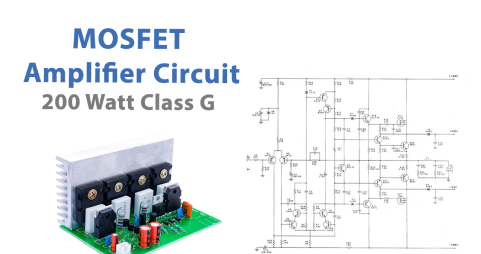
5、Class G Amplifiers: Class G and Class DG amplifiers optimize efficiency by adjusting the power supply voltage, making them suitable for applications that have higher efficiency requirements.
Class G Amplifiers use the highest power supply voltage only when necessary, whereas Class AB amplifiers always use the highest power supply voltage. As a result, Class G amplifiers are more efficient than Class AB amplifiers.
Figure 5. Class G amplifiers use the highest power supply voltage only when necessary, which results in higher efficiency compared to Class AB amplifiers.
6、Class DG Amplifiers: Class DG amplifiers use PWM to generate a full-swing, variable duty cycle digital output signal, similar to Class D amplifiers. They adopt the same dual power supply concept as Class D amplifiers, achieving even higher efficiency.
Figure 6. Class DG amplifiers detect the amplitude of the output signal and then switch power rails as needed, delivering the required power with higher efficiency.
Application Requirements:
First, define your application requirements, including the desired output power, impedance, audio quality, and more. Different application scenarios, such as home audio, professional audio, and car audio, have varying demands for amplifiers. Selecting the appropriate amplifier involves considering multiple factors. Below are some key points to help guide your decision-making process:
1、Efficiency and Power Consumption:
If your application has strict power consumption requirements, such as for portable devices, a Class D amplifier might be the best choice due to its high efficiency.
2、Audio Quality:
If high-fidelity sound quality is a priority, Class AB amplifiers might be ideal since they provide excellent sound quality with reasonable efficiency.
3、Power Supply Voltage and Output Power:
When selecting an amplifier, you should also consider the power supply voltage and the expected output power. Different amplifiers have different voltage requirements, which will impact your circuit design.
4、Thermal Management:
For high-power amplification, heat dissipation is a crucial consideration. Choose an amplifier that can effectively manage heat to ensure long-term stability and performance.
5、Cost and Size:
Based on your budget and space limitations, select an amplifier that offers a good balance of cost-effectiveness and appropriate size.
6、Brand and Technical Support:
Choosing amplifiers from well-known brands can ensure product quality and reliable technical support. For example, amplifiers from companies like Texas Instruments (TI) are widely trusted for their performance and support.
7、Technical Specifications:
Carefully review the technical specifications in the datasheet, such as gain, noise levels, bandwidth, and efficiency, to ensure that the amplifier meets your specific technical requirements.
Differences Between Digital and Analog Amplifiers
The main differences between digital amplifiers and analog amplifiers can be explained from the following aspects:
1、Operating Principle
Digital Amplifier:
A digital amplifier (Digital Amplifier) typically refers to a Class D amplifier. It converts the audio signal into a digital signal, which is then amplified and processed using digital signal processing (DSP) technology.
The operating principle of a digital amplifier is to convert the input analog signal into a PWM (Pulse Width Modulation) signal, then pass it through a low-pass filter to remove high-frequency pulse waves, restoring the signal back to an analog output.

Analog Amplifier:
An analog amplifier directly amplifies the analog signal without involving the conversion to a digital signal. Analog amplifiers include Class A, Class B, and Class AB amplifiers, each with different levels of efficiency and distortion performance during the amplification process.
2、Efficiency
Digital Amplifier:
Digital amplifiers are typically very efficient, often achieving over 90% efficiency. This is because they operate most of the time in a fully "on" or fully "off" state, reducing energy loss.
Analog Amplifier:
Analog amplifiers generally have lower efficiency, especially Class A amplifiers. This is because the transistors in these amplifiers remain in a constantly "on" state during the amplification process, leading to significant heat generation and energy loss.
3、Distortion
Digital Amplifier:
Digital amplifiers may introduce some distortion due to PWM modulation and digital processing. However, digital predistortion (DPD) techniques can effectively compensate for these distortions, resulting in improved audio quality.
Analog Amplifier:
The distortion in analog amplifiers primarily arises from the non-linearity of the circuitry. For example, Class A amplifiers tend to have low distortion, but their efficiency is lower. Class AB amplifiers strike a balance between efficiency and distortion, offering a compromise between sound quality and power efficiency.
4、Cost and Complexity
Digital Amplifier:
Digital amplifiers typically have lower IC costs because they require fewer analog components. They can use digital modulators and analog-to-digital converters (ADCs) to detect and adjust power fluctuations, improving performance while simplifying the overall design.
Analog Amplifier:
Analog amplifiers often require more complex circuit designs and tuning to ensure optimal sound quality and performance. This added complexity can increase both the cost and the difficulty of the design process.
5、Application Scenarios
Digital Amplifier:
Due to their high efficiency and the ability to adjust performance through digital technology, digital amplifiers are ideal for applications that require high efficiency and flexible configuration. These include car audio systems and environments with networked setups, such as smart home audio systems and portable devices.
Analog Amplifier:
Analog amplifiers are favored by some audiophiles and professional audio equipment users for their simpler circuitry and natural sound characteristics. They are commonly used in high-end audio systems where sound quality is the primary focus, such as in home audio setups and studio monitoring.
Conclusion
In summary, digital amplifiers and analog amplifiers differ significantly in terms of operating principles, efficiency, distortion, cost, and application scenarios. The choice of amplifier type depends on specific application requirements, such as power efficiency, size, and audio quality preferences.


 AR
AR
 EN
EN


