


 2025-11-25
 Author: Lennon
 Page view: 1887
Choosing the wrong amplifier can cause many problems. You may get weak sound, low volume,or even damage your equipment, The speakers may crackle or distort when the volume goes up and the amplifier may not have enough power for your space. But the right amplifier gives you clear sound, steady performance, and enough power for all your speakers. It also supports future expansion and keeps your system stable in daily use.
In 2025, new tech like IP audio, Class-D power modules, and line-array systems is becoming common. So choosing an amplifier is not only about traditional analog models anymore. You also need to understand modern, networked, high-efficiency options.
In this article, we will explain everything in a simple and practical way, so you can choose the amplifier that fits your needs.
1. What Is a Power Amplifier?
1.1 Concept
A power amplifier (PA) is simply the component of your sound system that makes sound sound. It accepts the small signal developed by a mixer, microphone preamp or media player and amplifies it sufficiently to make it able to actually power loudspeakers. You may consider it to be the kind of engine behind your speakers without it, even expensive speakers will not have the power to give the clear full sound they require.
1.2 Advantages
Power amplifiers offer several benefits that are essential to any professional or commercial audio setup:
- High power output
Enables speakers to reach the required volume with clarity and stability.
- Better sound quality
A good amplifier delivers powerful sound without adding distortion, so the audio still feels natural at higher volumes.
- System protection
Many amplifiers are equipped with temperature control, short-circuit protection, overload protection, and signal limiting to ensure the connected speakers remain safe.
- Scalability
Amplifiers come in a wide range of power ratings and designs, making it easy to find the right one for anything from a small meeting room to a large performance hall.
- Flexible integration
Modern amplifier designs support a wide range of setups, from pure analog systems to IP networks and hybrid solutions.
1.3 Typical Usage Scenarios
Background music and paging systems used in business areas such as retail shops, restaurants and company offices have amplifiers that operate all day long. Larger rooms- The auditoriums, theatres, and stadiums make use of high power amplifiers to provide a stable coverage and adequate levels of sound pressure over large areas of the audience.
2. Types of Power Amplifier
Modern amplifiers come in several categories, each serving different application scenarios.
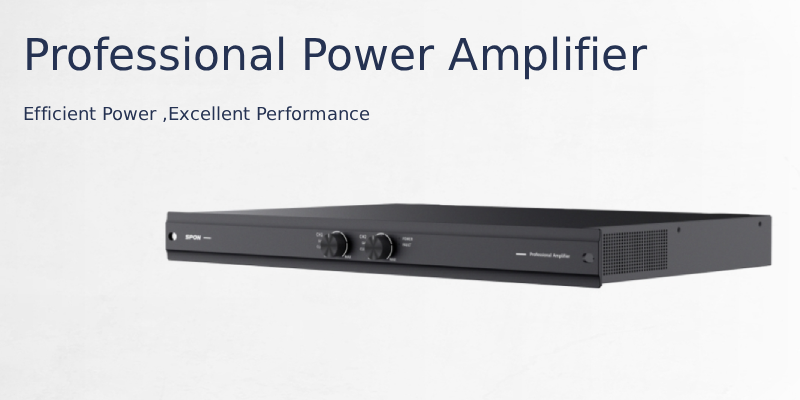
• Professional Audio Power Amplifier
- Designed for concerts, theaters, and auditoriums
- Delivers high output power (from several hundred to several thousand watts)
- Low distortion with a wide and accurate frequency response
- Typically offers 4Ω/8Ω outputs for low-impedance speaker systems
- Usually installed in equipment racks and requires professional tuning
• IP Network Amplifier
- Integrates IP audio decoding and power amplification in a single unit
- Receives audio streams over Ethernet (SIP/RTP/Multicast)
- Supports remote control, status monitoring, and fault reporting
- Ideal for campus broadcasting, shopping malls, and industrial facilities
- Significantly reduces wiring and installation costs
• Class-D Power Amplifier
- High-efficiency switching amplifier
- Efficiency up to 90% (low heat, energy saving)
- Lightweight, small size
- Commonly used in IP speakers, wall-mounted amps, 70V/100V line systems
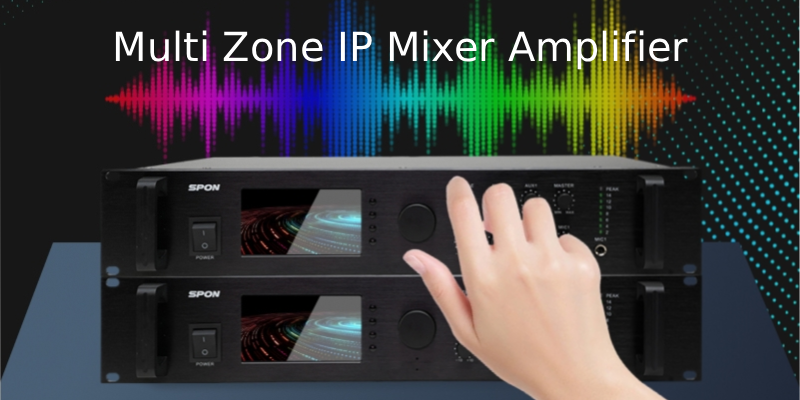
• Integrated Amplifier / Mixer Amplifier
Built-in mixer + amplifier
Input sources: microphones, line-in, Bluetooth, USB
Suitable for small rooms or portable systems
3. How an Amplifier Works
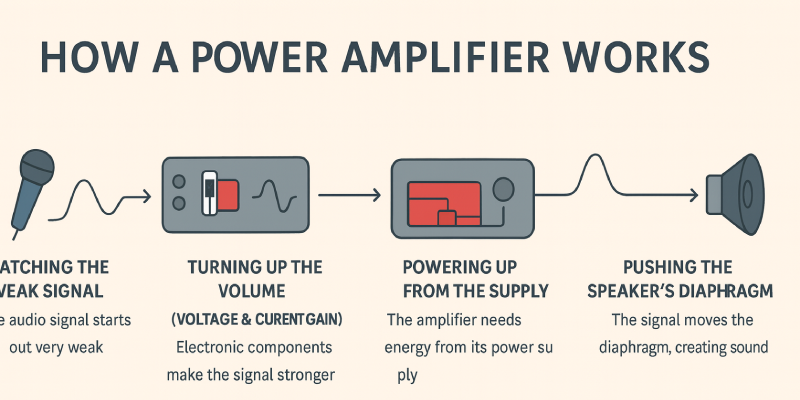
An audio power amplifier is primarily an audio signal amplifier that is capable of increasing a microscopic audio signal to a strength sufficient to cause loud speakers to operate. It is explained in straightforward terms, as follows:
Catching the Weak Signal
The audio signal starts as a very small voltage and is provided by such sources as microphone or mixer. Normally, only a few millivolts in the millivolt range - so minute that it cannot through it power speakers on its own - can be used. The role of the amplifier at this stage is to correct this weak signal to be further amplified.
Turning Up the Volume (Voltage & Current Gain)
Once the signal has been sent to the amplifier, the hard work begins. The small elements are tiny tubes or transistors hence electronic valves that come into play in order to increase voltage and current. They do not alter the personality of the sound; they merely add to it some of the muscle, as when one turns up a radio.
Powering Up from the Supply
A lot of energy is required by an amplifier to be played loudly. It takes that energy and draws it out of the power source, such as an engine drawing fuel, and sends a good signal that can power the speakers. The amp is the controlled element responding to the instruction set that is the input signal. The muscle is made to occur by the power supply.
Pushing the Diaphragm of the Speaker.
It is boosted with the signal and forwarded to the speakers. It then causes the voice coil to move the diaphragm, or better said the portion that will move the air to form sound. The greater the amp, the greater the range of the diaphragm, and the greater the volume of sound.
Pushing the Speaker's Diaphragm
With the signal boosted, it’s sent to the speakers. There, it drives the voice coil, which moves the diaphragm—the part that pushes air to create sound. The more power the amp delivers, the farther the diaphragm travels, and the louder the sound becomes.
Matching and Protecting
The last, but not the least, is that the amplifier should connect and guard all in the right way. It is adjusted to allow the necessitated load (4 ohms, 8 ohms or constant current lines such as 70 V/100 V) so that it conducts power efficiently. It additionally incorporates protection against overheating, short and over drive. Smart thermal controls ensure the temperatures are maintained, whereas the protection circuits allow the amp to operate safely even in heavy loads.
4. Key Specifications Explained
Output Power – The Core Performance Metric
One of the most important parameters during the choice of a power amplifier is its output power. It defines the highest power that the amplifier can produce without distortion to the speakers.
Common output power terms:
Rated Power (RMS/Continuous): The continuous, stable power the amplifier can output—this is the most useful and reliable figure.
Program Power: The maximum short-term power, typically about twice the RMS value.
Peak Power: The highest instantaneous power, which is usually up to four times the RMS number.
Tip for Selection:When you have 100W rated power of your speaker, then you would think that you use an amplifier with a rated RMS power of 100W to 150W.
Output Impedance & Load Matching
Speakers usually come in impedances of 4Ω, 8Ω, or 16Ω. It’s crucial that your amplifier and speakers are impedance-matched for optimal performance.
Low impedance → Higher current, higher power output, but the amplifier is under greater load.
High impedance → Lower current, lower power output.
Tip: Ensure the amplifier supports the speaker impedance, especially if you’re connecting multiple speakers.
• Frequency Response
This parameter describes the range of frequencies that the amplifier can handle effectively. The typical range for audio systems is:
20Hz – 20kHz ±1dB
The flatter the frequency response, the more accurate the sound reproduction, ensuring that no frequency range is overly emphasized or attenuated.
• Total Harmonic Distortion (THD)
THD measures the level of unwanted harmonics in the output signal. A low THD means the amplifier preserves the integrity of the original sound.
Typical values:
THD < 0.1%: Professional sound systems
THD < 0.5%: General broadcasting or PA systems
The lower the THD, the cleaner the sound.
• Signal-to-Noise Ratio (SNR)
SNR indicates the ratio between the desired signal and background noise. Higher SNR means less background noise.
Common standards:
≥ 80 dB: Suitable for general PA systems
≥ 95 dB: Professional audio systems
A higher SNR means cleaner, more detailed sound.
• Input Sensitivity
Input sensitivity refers to the required input signal strength needed for the amplifier to reach its rated output power.
Common values:
0.775V (0 dBu) ,1V , 1.4V
Why it matters:
It determines if your input source (mixer, network decoder, etc.) can "push" the amplifier to its full potential.
5. Common Interfaces of Power Amplifiers
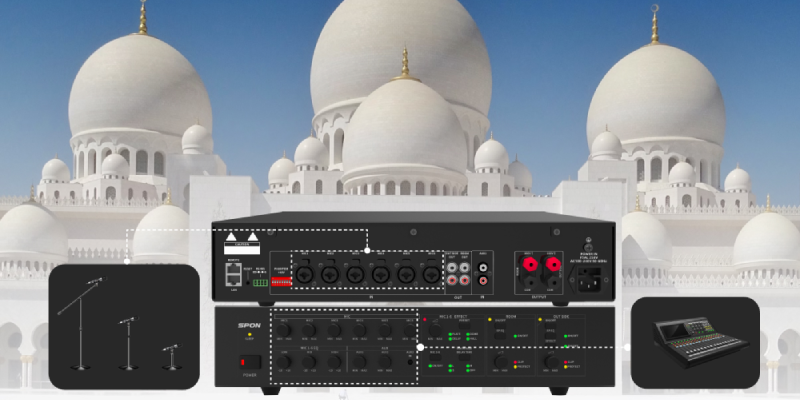
Modern power amplifiers typically offer multiple input and output options to accommodate different types of audio sources. The most common ones are:
5.1 Input Interfaces
5.1.1 XLR Balanced
In the case of professional audio, the most widespread and trusted form of input is XLR.
- High anti-interference capacity: Can be used in environments with complicated set ups or where there is considerable electromagnetic noise or interference.
- Long distance: Can transmit a number of tens of meters without serious signal loss.
- Professional equipment standard: The traditional one that is frequently used with mixers, audio processors, IP decoders, etc.
XLR input is nearly always provided on professional amplifiers since it is very reliable.
5.1.2 RCA Unbalanced
RCA is primarily applied in amateur level or background music systems.
- Uncomplex character and cheapness.
- Suitable in short distance connection (usually within 5 meters)
- Used in small media devices, home audio, and players.
Its anti-interference capability is lesser than XLR but it is adequate in a normal office or home set up.
5.1.3 Mic Input
Some amplifiers with built-in preamps provide microphone inputs.
- Supports MIC-level signals with high input sensitivity
- May provide 48V phantom power (depending on the model)
- Common in conference rooms, small classrooms, and multifunction room
Microphone inputs usually come with independent gain control and may include noise suppression or priority broadcast features.
5.2 Output Interfaces
5.2.1 70V/100V line output
This is the most common output type in public address (PA) and large-scale background music systems.
- Can connect multiple speakers in parallel, with the total number limited by the amplifier’s power
- Low signal loss over long distances
- Simple wiring, ideal for schools, hospitals, shopping malls, campuses, and other large areas
- Regional usage: 70V is common in North America; 100V is widely used in Asia, Europe, and large venues
5.2.2 4Ω/8Ω low-impedance output
Used for professional sound reinforcement or high-fidelity music playback.
- Better sound quality with wider frequency response
- Suitable for driving professional speakers, stage monitors, and theater systems
- Emphasizes power matching and transient response
- Requires relatively thick speaker cables (e.g., 2×2.5mm² or 2×4mm²)
5.2.3 SpeakOn Output
Used for connecting amplifiers to speakers in professional audio systems:
- High-power transmission, suitable for medium to large speakers
- Locking design ensures secure and reliable connection
- Supports multi-channel signals for flexible wiring
- Recommended to use speaker cables of appropriate specifications
6. How to choose the Right Power Amplifier
6.1 Step 1 — Identify Your Speaker System
Start by identifying the type of speakers you are using. This directly determines the category of amplifier required.
• Low-Impedance Speakers (4Ω / 8Ω)
Typically used in: theater, auditorium stage sound reinforcement, conference rooms.
Professional Power Amplifier is recommended.
Characteristics: powerful, good-sounding, large dynamic response.
• 70V / 100V Constant-Voltage Speakers
Usually found in: campuses, malls, corridors, factories, hotels.
Suggested amplifier: 70 V /100 V Line Amplifier.
Attributes: long distance communication, very large group of simultaneous speakers, minimal wiring losses.
• IP Network Speakers (IP Speaker)
Applications: IP PA systems, intelligent buildings, campus broadcasting.
Suggested amplifier: IP Amplifier (or speakers that have inbuilt IP amp module)
Features: SIP/RTP/multicast streaming, remote monitoring, control and diagnostics.
Select the type of the speaker first then the amplifier.
This will be the initial and most crucial step.
6.2 Step 2 — Calculate the Required Power
Power estimation is critical for choosing the proper amplifier.
• Low-Impedance Systems
Amplifier output power =1.5-2x speaker RMS power.
Example: Speaker RMS = 200W
Recommended amplifier: 300-400W /channel.
Why?
- Additional headroom is used to avoid clipping and distortion. - Amplifiers that are underrated are more dangerous than those, which are slightly overrated.
• 70V/100V Constant-Voltage Systems
Required amplifier power = Total speaker wattage × 1.3–1.5
Example: 10 × 10W ceiling speakers → 100W total
Recommended amplifier: 130–150W
6.3 Step 3 — Ensure Proper Impedance Matching (Very Important)
The amplifier output must match the speaker load.
| Speaker Type | Amplifier Output | Compatible |
| 4Ω / 8Ω | Low-impedance output | ✔ Yes |
| 70V / 100V | Constant-voltage output | ✔ Yes |
| 4Ω → 100V amplifier | ✘ Never | |
| 100V speaker → low-impedance amplifier | ✘ Never |
Incorrect matching can result in amplifier damage, speaker failure, or no output at all.
6.4 Step 4 — Determine the Required Features
Choose amplifier features based on your application.
• Do You Need DSP?
DSP functions may include:
Equalizer (EQ) , Crossover , Limiter , Delay
Professional amplifiers and IP amplifiers commonly include DSP and are ideal for systems requiring tuning.
• Do You Need Network Capabilities?
IP amplifiers typically support:
Web configuration ,Status monitoring (temperature, load, faults) , Remote broadcasting (SIP/RTP/multicast)
Essential for large campuses, factories, transportation hubs, and hospitals.
• Do You Need Multi-Zone Output?
A mixer amplifier or IP amplifier allows:
Zone selection , Single-zone paging , Priority emergency announcements
6.5 Step 5 — Consider Reliability & Protection
Reliability determines whether a system can operate continuously and safely for years.
• Choose amplifiers with the following protection features:
Short-circuit protection ,Overload protection , Over-temperature protection
Clip limiter ,DC protection , Soft-start protection
• Thermal management is equally important:
Adequate heat dissipation ,Efficient Class-D architecture (reduces heat generation) ,
Suitable for rack installation with ventilation
6.6 Step 6 — Choose the Amplifier Class (Sound vs. Efficiency)
• Class-AB Power Anplifier
Excellent audio quality ,Low distortion , Higher heat output
Best for concerts, performance venues, and high-fidelity applications.
• Class-D Power Amplifier
Very high efficiency (85–90%) ,Low heat generation ,Lightweight and compact ,
The mainstream choice in 2025, especially for IP and 70V/100V systems
If you are unsure which class to choose, Class-D is the recommended default choice for most modern installations.
7. Application
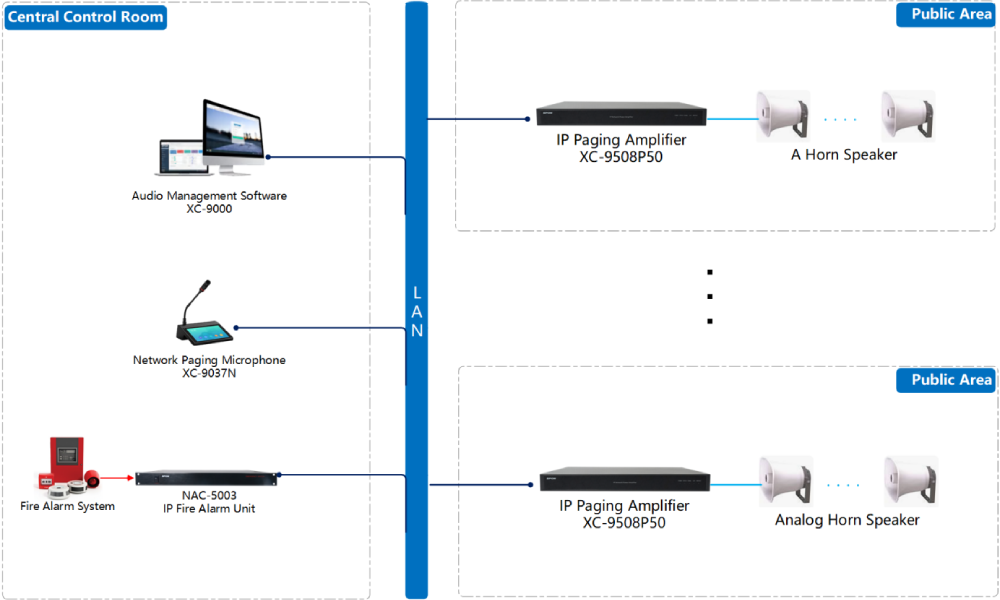
7.1 IP Amplifier Applications
Modern audio distribution systems have extensively used IP (networked) amplifiers due to their scalable nature and flexibility. Typical scenarios include:
PA Systems on campus and corporations.
Having IP amplifiers enables the management and control of numerous zones on a regular network at a central point. Administrators have the ability to broadcast announcements, set messages or even play background music in the classrooms, offices or even meeting rooms.
Smart Public Facilities and Buildings.
These amplifiers can be linked easily with the building management systems (BMS) and emergency alert systems with IP connectivity. To illustrate, in case of a fire alarm, the system by default can send evacuation messages through IP amplifiers in the affected regions.
Large-Scale Audio Networks
IP amplifiers can be used at shopping malls, airports or transportation centers to allow audio to be distributed over multiple zones thereby enabling one to play various content in one or more zones at the same time without compromising on the quality of audio.
✮ Key Advantages:
Centralized control and monitoring
Easy expansion and zone management
Integration with IP-based emergency and automation systems
✮ System Topology
7.2 Professional Amplifier Applications
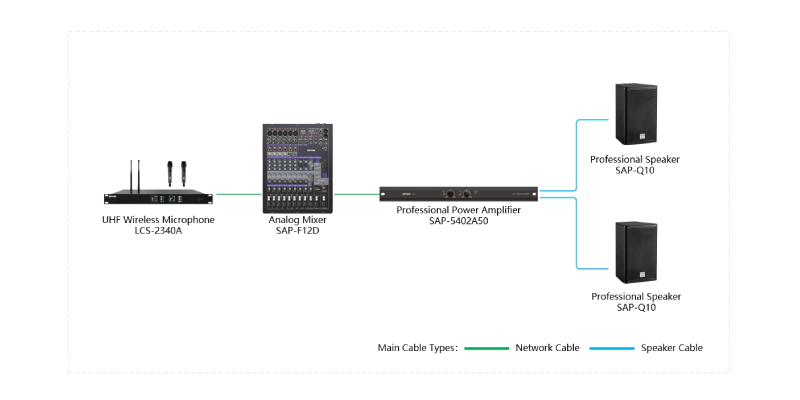
Professional low-impedance amplifiers are the backbone of high-fidelity sound reinforcement systems. Typical applications include:
Concert Halls and Theaters
These amplifiers drive stage monitors and main PA speakers, providing high-quality sound reproduction with wide frequency response and dynamic headroom.
Live Music Venues and Clubs
Professional amplifiers ensure powerful, distortion-free audio output, suitable for dynamic music performances and large audiences.
Corporate and Conference Venues
When high clarity and intelligibility are required, professional amplifiers paired with ceiling or wall-mounted speakers ensure every attendee can hear presentations and announcements clearly.
✮ Key Advantages:
Superior audio fidelity and transient response
Compatibility with a wide range of professional loudspeakers
Reliable performance under high power demand
✮ System Topology
8. Conclusion
Choosing the right amplifier is essential for achieving good sound quality, system stability, and long-term reliability.
By understanding amplifier types, key specifications, and system requirements, you can confidently select the correct device for your project—whether it is a small meeting room, a whole campus broadcasting system, or a full-scale professional PA system.
9. Q&A
Q1: Can I connect a 4Ω speaker to a 100V amplifier?
No. 100V line amplifiers require matching 100V speakers. Never mix low-impedance speakers directly.
Q2: How much power do I need for my system?
Sum the speaker power (RMS) and add at least 20–30% headroom.
Q3: Do IP amplifiers reduce wiring cost?
Yes. Only Ethernet cable is needed, and audio/control/power (PoE models) can be unified.
Q4: Is Class-D better than Class-AB?
For PA systems, yes—Class-D is more energy-efficient and compact, making it ideal for modern installations.
Q5: Can one amplifier drive multiple zones?
Some models support multi-zone outputs; otherwise, use an audio matrix or separate amplifiers.


 AR
AR
 EN
EN


