IP PA System VS Analog PA System: 9 Key Differences
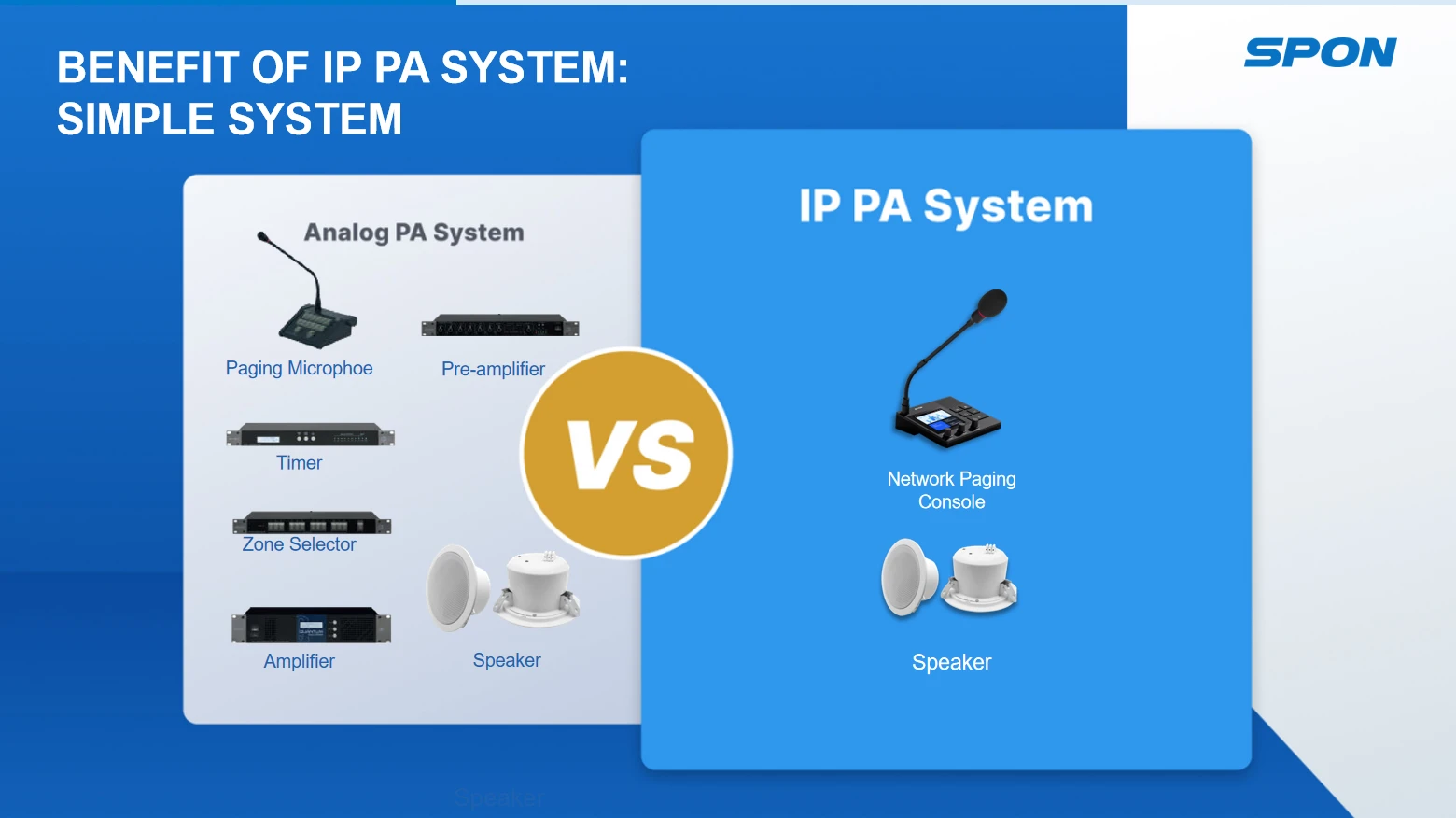
The analog PA system is a traditional solution, while the IP PA system has become the mainstream choice today. This article introduces the differences between analog and IP PA systems to help you select the most suitable system for your project implementation.Public address systems play an important role in our daily lives, e.g., scheduled bells on campuses, safety alerts in factories, background music in shopping malls, and voice announcements in stations. This article introduces analog and IP PA systems from the perspectives of definitions, working principles, system components, and typical topology diagrams, aiming to help you choose the most suitable PA system during project design.
Analog PA System
1.1 System Definition
The analog PA system is a traditional broadcasting solution. It uses analog audio signal transmission technology and delivers amplified sound through 70V or 100V constant-voltage lines.
1.2 Transmission Principle
The transmission principle of an analog PA system is relatively simple. At its core is the “direct transmission of analog signals.” The process can be divided into the following parts:1. Audio AcquisitionMicrophone captures sound waves, and then converts them into continuous analog electrical signals. The amplitude and frequency of these signals vary continuously with the sound to maintain consistency with the original sound waveform.2. Signal ProcessingThe analog electrical signal is transmitted to audio processing equipment (e.g., a mixer), where it undergoes volume adjustment, tone optimization, mixing, and other processing to produce a suitable output signal.3. Signal AmplificationThe suitable analog signal from the mixer will be sent to a constant-voltage power amplifier. The amplifier boosts the signal to a 70V or 100V high-voltage, low-current level, so that it can drive the latter speakers.4. Sound ReproductionThe 70V or 100V high-voltage, low-current signal is transmitted via dedicated copper cables to each speaker. Inside the speaker, a step-down transformer converts the high-voltage signal into an appropriate level for the speaker, which then converts it back into sound waves for playback.
1.3 System Composition
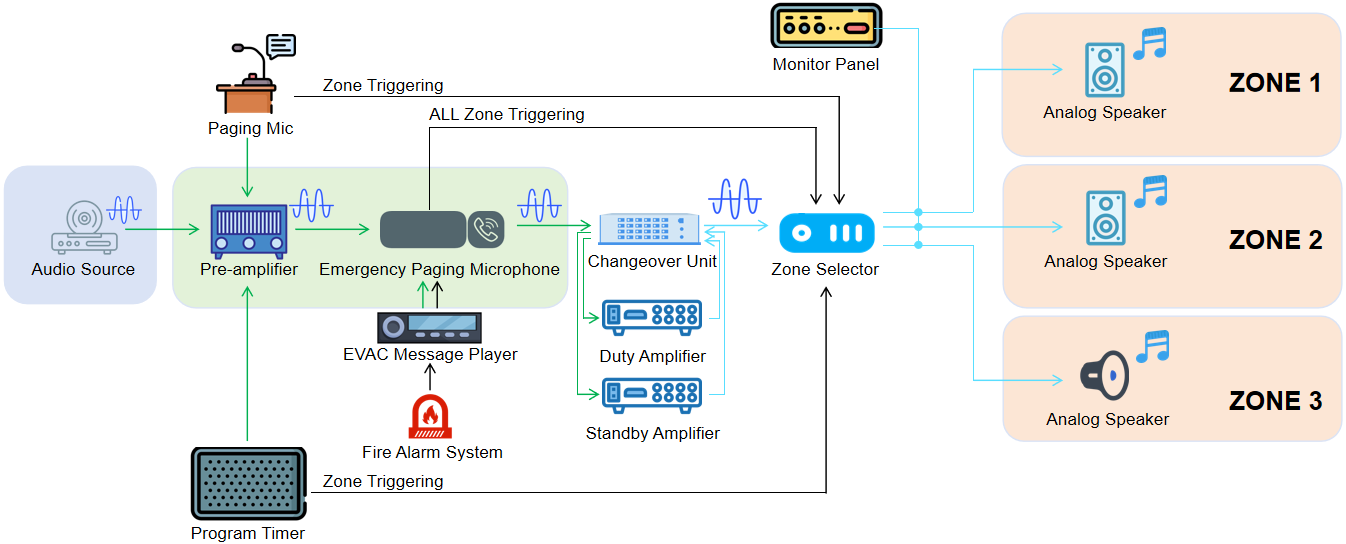
The analog PA system typically consists of audio sources (e.g., microphones and multimedia players etc.), audio processing equipment (e.g., preamplifiers and mixers etc.), constant-voltage power amplifiers, speakers, and transmission lines. In some cases, additional devices are included to meet specific application requirements, e.g., zone selectors, program timers, and message players etc.
To use multi-channel switches or relay matrices to control audio on/off in different areas under the command of a main control device (e.g., a paging microphone or program timer etc.), enabling zoned broadcasting.
Predefined schedules are set to automatically trigger playback at specified times.
To play corresponding voice messages or audio upon receiving a trigger signal.
1.4 Typical Topology Diagram
IP PA System
2.1 System Definition
The IP PA system is a broadcasting solution based on the TCP/IP protocol. It transmits audio and control signals in the form of data packets over local area networks (LAN) and wide area networks (WAN), enabling audio broadcasting, control, and management.
2.2 Transmission Principle
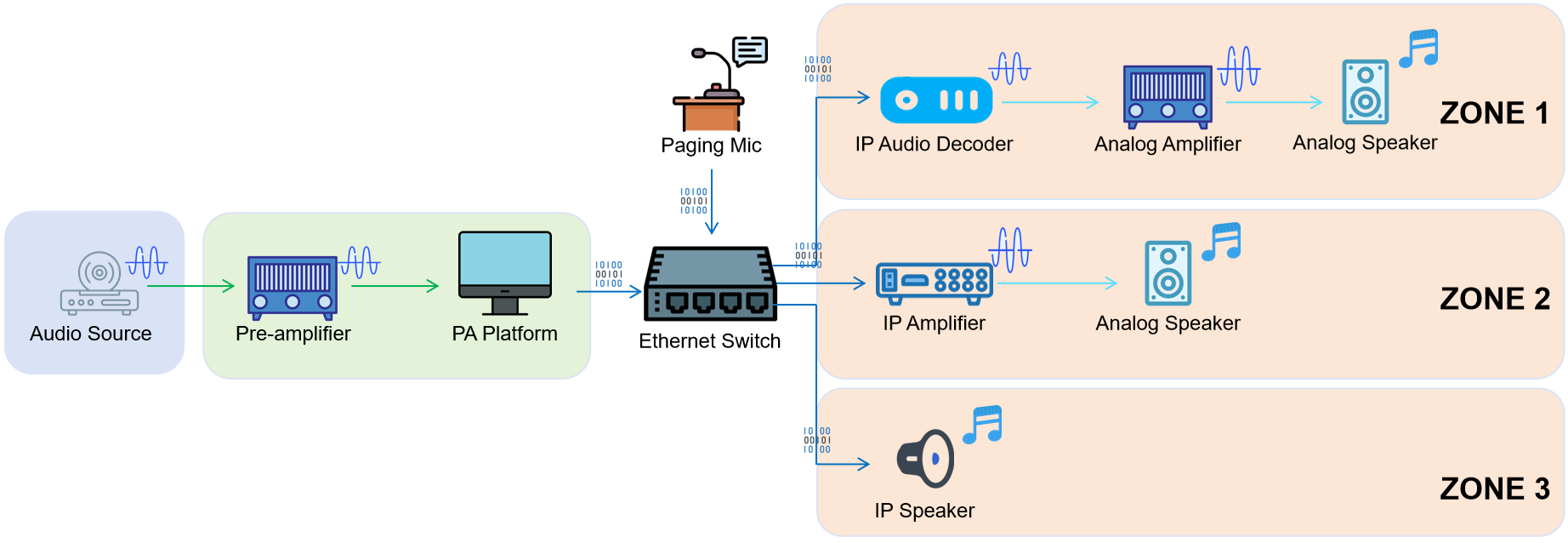
In simple terms, the transmission principle of an IP PA system is that audio signals are converted into digital form, transmitted to designated IP PA terminals over the network, and then converted back into sound. The process can be divided into the following parts:1. Audio Acquisition and DigitizationAudio is captured through an IP microphone, or traditional analog audio signals (e.g., multimedia players etc.) are converted into digital signals via an audio encoder. The digital signals are compressed into data packets and embedded with IP address information to locate the target IP PA terminals.2. Network TransmissionThe data packets are transmitted over an IP network. Through routers and switches, the packets are accurately delivered to designated terminal devices, e.g., IP decoders, IP amplifiers, and IP speakers.3. Digital-to-Analog Conversion and Audio OutputTerminal devices (e.g., IP decoders, IP amplifiers, IP speakers) receive the data packets and decode them into analog signals. These signals are then amplified by built-in or external amplifiers and finally converted into sound waves by speakers to realize audio broadcasting output.
2.3 System Composition
The IP PA system mainly consists of IP paging microphones, a system server, IP speakers (or IP amplifiers with constant-voltage speakers, or IP decoders combined with constant-voltage amplifiers and speakers), and IP network infrastructure. In some cases, additional devices are included to meet specific application requirements, e.g., encoders and fire alarm interface devices etc.
Responsible for device registration, zoning, audio storage, task scheduling, and transmission management across the entire system.
Encodes external analog audio sources and broadcasts them to IP terminals within the system.
Integrates with fire alarm systems to automatically trigger the playback of alarm audio.
2.4 Typical Topology Diagram
What are the main differences between analog and IP PA systems?
| System Category |
Analog PA System |
IP PA System |
| Sound Quality |
Poor |
High fidelity (CD level) |
| Interference Resistance |
Easy to interference |
Strong interference resistance |
| Wiring |
Separate wiring |
Reused network cable |
| Expansion |
Difficult |
Plug and play, just connect to the network |
| Management |
Local management |
Web/APP remote management |
| Functionality |
Relatively simple |
Powerful, supports on-demand, intercom, linkage, etc. |
| Applicable Scenarios |
Small scale |
Suitable for small/medium/large scales |
| Maintenance |
Requires checking cables segment by segment and troubleshooting equipment individually when a fault occurs, time-consuming and labor-intensive |
Software allows remote monitoring of the operating status of all PA equipments, timely fault detection and remote troubleshooting, simple maintenance |
| Cost |
Low system cost, but high maintenance cost |
High system cost, but low maintenance cost, higher cost-effectiveness |
How to choose a suitable PA system?
When choosing between an analog PA system and an IP PA system, the key is to match your actual needs. There is no need to blindly pursue a more “advanced” IP system, nor to choose an analog system simply to reduce costs if it does not meet your requirements.(1) For small-scale projects with simple functions, limited budgets, no system integration, and no future expansion needs, an analog PA system is recommended.(2) For large-scale projects with complex functions, sufficient budgets, system integration requirements, and future expansion needs, an IP PA system is recommended.
Summary
This article has briefly introduced the definitions, components, working principles, and project selection guidelines for both analog and IP PA systems. Analog PA systems represent traditional solutions, while IP PA systems are now the mainstream, offering more powerful features and a wider range of application scenarios, e.g., schools, hotels, factories, transportation systems, and tourist attractions etc. If you have PA system needs in these scenarios, you can explore our solutions or contact us for further support.
Tailored Solutions for Every Industry: Explore IP PA and Intercom Systems



 2026-04-10
 Author: Aaron
 Page view: 1170


 AR
AR
 EN
EN


.png)


