Cookies Setting
We use cookies to improve your browsing experience, analyze traffic, and personalize content. By using this site, you agree to our use of cookies. For more details, please check our Cookie Policy.
Home News

IK Protection Rating Explained: IK00 to IK10

IK Protection Rating Explained: IK00 to IK10
2025-12-16 Author: Lennon Page view: 4796
The gadgets employed in the social or outdoor settings are usually subject to unintentional knocks, bumps, and even deliberate destruction. The IEC 62262 standard presents the IK rating to determine the level of resistance of an enclosure to such mechanical impacts. This rating is the expression of impact resistance in joules, which assists engineers and integrators of the system to select equipment that is able to resist actual physical stress. This paper gives a short description of what IK ratings are, and what their application is to real world installation applications.

Table of Contents

What is an IK Protection Rating?

1.Definition

The IK Protection Rating is a worldwide standard outlined in the IEC 62262, which is exploited to categorize the degree of safeguarding against outside mechanical power that an electrical enclosure offers. This rating is presented as IK and a number (00~10) with numerical finding higher than 10 referring to a higher resistance to impact.

2. Purpose and Importance 

The IK rating assists the engineers and consumers to rate the capability of the device to withstand unintentional shocks, intentional damage, or severe weather conditions. This makes sure that product like outdoor speakers, cameras, lighting fixtures and industrial equipment are safe and dependable during the period they are in use.

IK Level Classification and Explanation

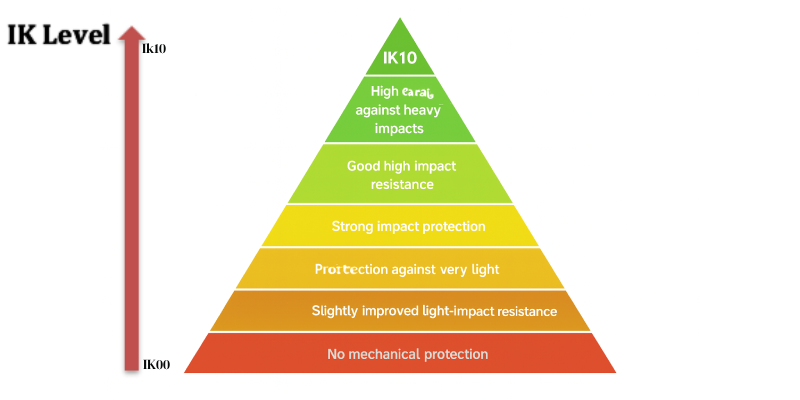
IK protection rating determines the capacity of an enclosure in resisting external mechanical forces, since engineers and system integrators are able to make a rapid decision on how long a device will last. The better the IK level, the more influence energy it is capable of sustaining, light, incidental contact at IK01 to vandal-resistant extreme impact at IK10. The classification table below summarizes each IK level, impact energy in joules of each level, and the common applications, which should give a good point of reference on the appropriate level of protection taken in various surroundings.
IK Rating Impact Energy(J) Description Typical Applications
IK00 0 J No mechanical protection Indoor devices with no impact requirements
IK01 0.15J Protection against very light impacts Light indicators, small control units
IK02 0.20J Slightly improved light-impact resistance Office electronics, basic panels
IK03 0.35J Resistance to low-energy impacts Indoor switches, light-duty enclosures
IK04 0.50J Suitable for general indoor use Keypads, control panels
IK05 0.70J Moderate resistance Industrial control devices, equipment panels
IK06 1.00J Good resistance to everyday impacts Commercial lighting, public indoor terminals
IK07 2.00J Strong impact protection Outdoor panels, access control readers
IK08 5.00J High durability against heavy impacts Public devices, wall-mounted speakers, CCTV housings
IK09 10.00J Very high impact resistance Outdoor IP speakers, industrial terminals, anti-vandal units
IK10 20.00J Maximum protection under the standard Transport hubs, prisons, high-risk areas, anti-vandal enclosures
The IK protection rating is an important concept that should be understood in order to design and install effective electrical enclosures. The level of impact energy and common application of this device to be used can be determined, which is known as the IK level, after which a decision can be made to make sure that it will be safe and operable at any mechanical stress. Be it the indoor equipment more prone to occasional knocks or equipment installed in an outdoor area where it may be prone to vandalism, the proper choice of IK rating allows improving the product life, safety and performance.

IK Test Methods

Standardized test methods that are prescribed in IEC 62262 are employed to establish the IK protection rating of an enclosure. These tests are reproduced to mimic mechanical impacts of diverse energies to test the resistance of the device. The main methods include:

1.Drop Hammer Test

This technique entails falling of a given mass (hammer) of a known height on the enclosure in order to replicate the energy of impact at the level of IK under test.
  • Purpose: Determine the strength of impact, crack/bruise resistance, deformation and failure threshold.
  • Typical standards: ASTM D4272, D2444 (plastics/pipes), ISO 6603 (plastics), IEC 60068-2-31 (electronics), EN 13049 (furniture), UL 746F (plastics).
  • Methods:Constant mass, adjustable altitude (energy = mgh).Fixed height, variable mass.Instrumented striker measures force, time, energy and displacement.
  • Key parameters: striker mass/geometry, drop height, impact energy, support/anvil type, specimen conditioning and temperature, number of hits.
  • Results: pass/fail at specified energy, critical drop height, impact energy to failure, fracture mode, dents/deformation.

2.Spring Impact Hammer Test

In this method, a spring-loaded hammer delivers precise impact energy to the enclosure. The spring mechanism ensures consistent impact force and allows testing at different IK levels. This method is particularly useful for lower-energy impacts where controlled, repeatable application is critical.
  • Purpose: Verify enclosure robustness, sharp edge/break risk, and safety under everyday knocks.
  • Typical standards: IEC 60068-2-75, IEC 60950/62368, IEC 60601, EN/UL 62262 (IK codes), GB/T 2423.55.
  • Energy levels: Commonly 0.2 J to 2 J (and higher), mapped to IK ratings (e.g., IK07–IK10).
  • Equipment: Calibrated spring hammer with defined mass, tip geometry, and release mechanism; rigid support/anvil.
  • Methods:
Condition specimen; mount per standard.Select impact energy; perform specified number of hits at defined points (edges, corners, weak spots).Inspect for cracks, loosened parts, safety hazards; functional check if required.
  • Key parameters: impact energy (J), impact locations/angles, number of impacts, tip type, specimen mounting, ambient temperature.
  • Results: no hazardous live-part access, no sharp edges, no functional damage beyond limits set by.
 

IK and Product Design

To design a product to achieve a particular level of IK protection, a thorough balance must be maintained between the product structure, the choice of materials, and the methods of manufacturing, as well as real usage requirements. The objective is to make the enclosure capable of resisting mechanical forces without affecting the safety, functionality or aesthetics.

Material Selection

The right material is the key to the achievement of the demanded IK rating.
  • Metals (e.g., steel, aluminum): Have high impact and deformation resistance and can be used in applications with high IK (e.g., industrial equipment, outdoor CCTV casing, and infrastructure).
  • Plastic engineering (e.g., PC, ABS, PC+ABS): A balance between strength, weight and cost. Polycarbonates are also common in the case where optical transparency and high impact resistance are needed.
  • Composite materials: Composite materials are applied in special purposes to make them more durable and less weighty.
2. Structural ReinforcementundefinedundefinedWhen impact energy is received, structure can in spite of good materials can spread it.
  • Rib and internal reinforcements: These enhance rigidity and minimize chances of cracking at the moment of impact.
  • Round and Curved: Catalyze the dispersion of load rather than loading at one point.
  • Optimal wall thickness: Provides sufficient strength without any unjustified weight or expense.

3. Surface and Finish Design

Appearances and protection are also important in the long-term work of the surface, which requires surface treatment.
  • Rough surfaces conceal the scratches which might be created during the impact.
  • Outdoor products experience anti-UV treatment to protect against aging and brittle nature, sustaining performance of the IK of the product in the long term. 
  • The use of anti-corrosion treatments (metal enclosures) is to make sure that structural integrity is not compromised through rusting. 

4. Mounting and Installation

 The same device can be used to pass the impact testing at the laboratory, but get faulty when improperly installed at the field. 
  • Strong fixing mechanisms: Screws, brackets, mounting plates should also be compliant with overall IK requirement in order to not detach under impact. 
  • Vibration and shock issues: This is of particular concern to industrial, transportation, or public-area equipment. 
  • Wall compatibility, poles compatibility, ceiling compatibility: This can impact the effective IK performance as the incorrect installation surface is used. 

5. Protection of Components within the enclosure. 

IK rating protects the enclosure, however impact mitigation is required on the internal components as well. 
  • PCBs, sensors or optics are covered with internal shock-absorbing pads or foam. 
  • Floating mounting structures lessen the delivery of impulse force to the fragile components. 
  • Cable strain relief is used to ensure that connectors do not lose their grip during mechanical strain. 

6. Environmental and Application Requirements. 

The IK required is based on the development of the application scenario. 
  • Open spaces (transit stations, institutions, hospitals): More IK (IK0810IK) to ensure vandalism and unintentional crashes do not occur.
  • Implant: The interior equipments can be appreciated with a which style is less important, but rather the cost. 
  • Outdoor applications: IK10 is usually used together with IP65/66/67 to withstand dust and water.

IK vs. IP Ratings: What’s the Difference?

Both IK and IP rating are normally used when determining the strength of electrical housing and outdoor equipment. Even though they are usually used interchangeably, they quantify entirely different things of protection, and the relationship of the two is critical to their effective product selection and engineering design.

1.What Each Rating Measures

Rating Standard Focus of Protection What it measures
IK Rating IEC 62262 Mechanical impact resistance The ability of an enclosure to withstand external impacts expressed in Joules.
IP Rating IEC 60529 Ingress protection Protection against solid objects (dust) and liquids (water) entering the enclosure.
In short:IK = Impact resistanceIP = Dust & water resistanceThey complement each other but cannot replace one another.

2.Why Both Ratings Are Needed

An impact-resistant product is not one having high IP rating. In a similar manner, a device of high IK may not be waterproof.undefinedExamples:undefinedAn IP66 CCTV camera can withstand heavy rains but might otherwise be affected through vandalisms unless it is IK-rated.undefinedAn IK10 enclosure made of a metallic material may be very sturdy and robust in a strong mechanical impact, and could fail in a dusty or wet environment with a IP20 only.undefinedThe real-life uses tend to demand the combination of both performance dimensions to be completely launched.undefinedundefined3. Industry combinationsundefinedIP and IK ratings are matched by different applications to provide the proper environmental and mechanical requirements:Outdoor surveillance cameras: IK10 + IP66/IP67.There are between 50 and 100 m² loudspeakers, which are used in public areas: IK081K10 + IP55.Industrial control panel: IK08 + IP54/ IP65.Street or tunnel illuminating lamps: IK08–IK10 + IP66.The combinations are used to make the equipment physically strong and environmentally sealed.

Real-world Examples

IK Based IP Intercom in Prison

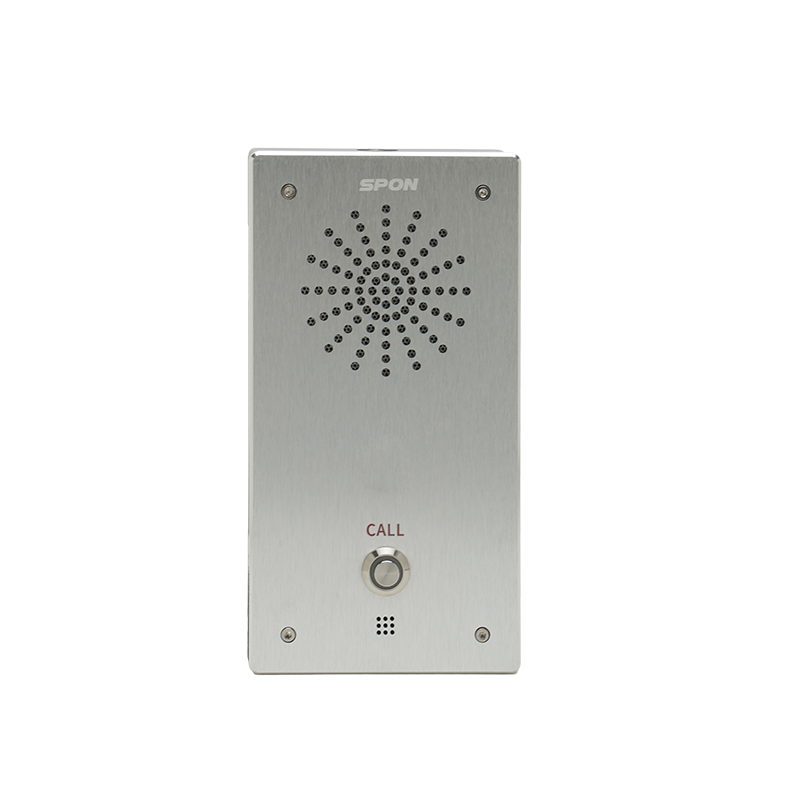
Prisons need the communication devices that are capable of withstanding the misuse, the attempts of vandalism, and the accidental acts of influence. A special IK-rated IP intercom has been especially designed to continue working even when subjected to extreme mechanical force.These are important features like:
  • High-strength metal casing: This standard range IK08-IK10, may withstand purposeful knocks, kicks, or strikes.
  • Tamper-proof design: Screws, mounting plates and push buttons are strengthened so that they cannot be removed or damaged forcibly.
  • Audio communication: The system can maintain its audio communication status, despite high impact, with internal microphone, speaker and PCB being cushioned with shock absorbing internal structures.
  • Safety critical reliability: The intercom should be usable all the time to enable emergency reporting, check on inmates and communication between staff and inmates.
They are typically located in cells, corridors and areas controlled by the installation of these intercoms in a prison and guarantee not only durability but constant security communication despite physical abuse.

2. IK Based Surveillance Microphone in Prison

Microphones used in law facilities to do surveillance should be able to offer good audio surveillance despite facing aggressive or unpredictable body condition. A surveillance microphone that meets the requirements of IK increases dependability in these very risky settings.
 
  • Small and shock-resistant casing: IK08-IK10 protection makes sure that the microphone remains operational even after being hit or knocked down.
  • Guarded acoustic elements: Acoustic chamber, mesh jackets, and internal pickups are made to avoid deformation upon impact and to preserve audio quality.
  • Vandal-resistant installation: Flush-mounted or recessed installation allows inmates no chance to grab, twist, and pull the device.
  • Stability: The IK protection enables stability during the long-term with prevention of the cracking or misalignment of enclosures that would otherwise compromise the audio quality or cause maintenance problems.
They are normally installed in high-security areas, corridors and interrogation rooms. Offered with good IK protection, they provide constant audio surveillance and provide the ability to run real time security monitoring and the investigation of events.

Conclusion

The critical trait that is taken into consideration when analyzing the mechanical strength of electrical enclosures in modern installations is the IK protection rating. IK rating gives engineers, integrators and end users a uniform measure of impact resistance with which to arrive at final decisions when choosing devices to be used in locations where there is a high probability of accidental collisions, vandalism or rugged operating conditions. The knowledge of IK levels and test methods and how these ratings vary compared to the IP ingress protection can prevent the most common misunderstandings and allow matching equipment to the environment it is expected to be used in.undefinedIn the practical world applications like prisons and transport centres, outdoor public instalations, user IP intercoms, surveillance microphones, speakers, and the control panels uses IP protection devices that are well-armoured at IK protection to ensure constant working and the reliability of the systems. Practical requirements In order to have the desired IK performance, good product design is necessary such as choice of material, structural reinforcement, and good installation of the products.undefinedFinally, the appropriate IK rating improves durability, product life, and safety of a very diverse scope of projects. Due to the addition of the IK protection and an appropriate balance between the IP ratings, system designers can provide solutions which are more resilient to both environmental and mechanical factors.
FAQS
Q1: What does an IK rating actually measure?
The IK rating measures how well an enclosure can withstand mechanical impact energy, expressed in joules. It reflects resistance to knocks, strikes, or vandalism from external forces—helping determine where a device can be safely installed.
Q2: What’s the difference between IK and IP ratings?
IK = impact resistance (mechanical force, hammer-like impacts) IP = ingress protection (dust and water protection) They are independent. A device may have a high IP rating but a low IK rating, or vice versa.
Q3: Does IK10 mean a device is unbreakable?
No. IK10 means the enclosure withstands 20 joules of impact energy, which is extremely strong, but it does not guarantee resistance to extreme vandalism such as tools, repeated heavy strikes, or intentional destruction beyond the standard test.
Q4: How is impact energy calculated in IK tests?
Impact energy (J) =mass of hammer (kg) × gravity (9.81 m/s²) × drop height (m) The IEC 62262 standard specifies hammer weight and drop height for each IK level.
Q5: Do all outdoor devices need IK10?
Not always. IK07–IK08: outdoor access panels, CCTV housings IK09: industrial areas, outdoor speakers, exposed public devices IK10: vandal-prone environments (stations, schools, prisons) Choose the rating based on risk level, not simply indoor/outdoor.
Q6: Does a higher IK rating affect product design or cost?
Yes. Achieving higher IK resistance often requires: •Thicker or reinforced enclosures •Tougher materials (metal, PC+ABS, tempered glass) •Shock-dissipating design This can increase both material cost and product weight, so manufacturers typically balance protection with price and application needs.