Cookies Setting
We use cookies to improve your browsing experience, analyze traffic, and personalize content. By using this site, you agree to our use of cookies. For more details, please check our Cookie Policy.
Home News

PA Speaker: The Complete B2B Buyer's Guide for 2026

PA Speaker: The Complete B2B Buyer's Guide for 2026
2026-05-27 Author: SPON Page view: 639
A PA speaker, short for public address speaker, converts an electrical audio signal into clear sound for public communication. In commercial and industrial environments, PA speakers are part of a larger communication system that may include microphones, amplifiers, DSP processors, IP networks, fire alarms, VoIP systems, and emergency notification platforms.Today’s PA systems are used in schools, hospitals, offices, factories, transportation hubs, retail stores, hotels, and public venues. A ceiling speaker in a hospital may quietly page medical staff. A horn speaker in a factory may broadcast emergency alerts over heavy machinery noise. Industry reports continue to show steady growth in the PA speaker market, driven by smart-building upgrades, safety regulations, and the expansion of IP-based communication systems.

Table of Contents

What Is a PA Speaker?

A PA speaker, short for public address speaker, converts an electrical audio signal into clear audible sound. Every public address system — from a small portable setup at a trade show to a large multi-building installation in a factory or campus — depends on PA speakers to deliver announcements, alerts, music, or emergency messages to listeners.In commercial and industrial environments, PA speakers are usually evaluated based on three main factors:
  • Coverage — how much area the speaker needs to cover with clear and intelligible sound.
  • Environment — whether the installation is indoor or outdoor, quiet or noisy, or affected by echo and reverberation.
  • Integration — how the speaker connects with the rest of the communication system, including amplifiers, VoIP phones, fire alarms, access control systems, and IP networks.
In most B2B projects, speech intelligibility is more important than maximum volume. A speaker that is loud but unclear cannot effectively deliver announcements or emergency instructions. In many commercial environments, the target is for the audio level to remain at least 10–15 dB above the background noise level at the listening area.PA speakers are different from home hi-fi speakers or studio monitors. They are designed for continuous operation, wide-area coverage, durability, and reliable performance in demanding environments. Modern IP PA speakers can also integrate directly with network infrastructure, allowing centralized control, remote management, and multi-zone audio distribution across large facilities.

6 Types of PA Speakers

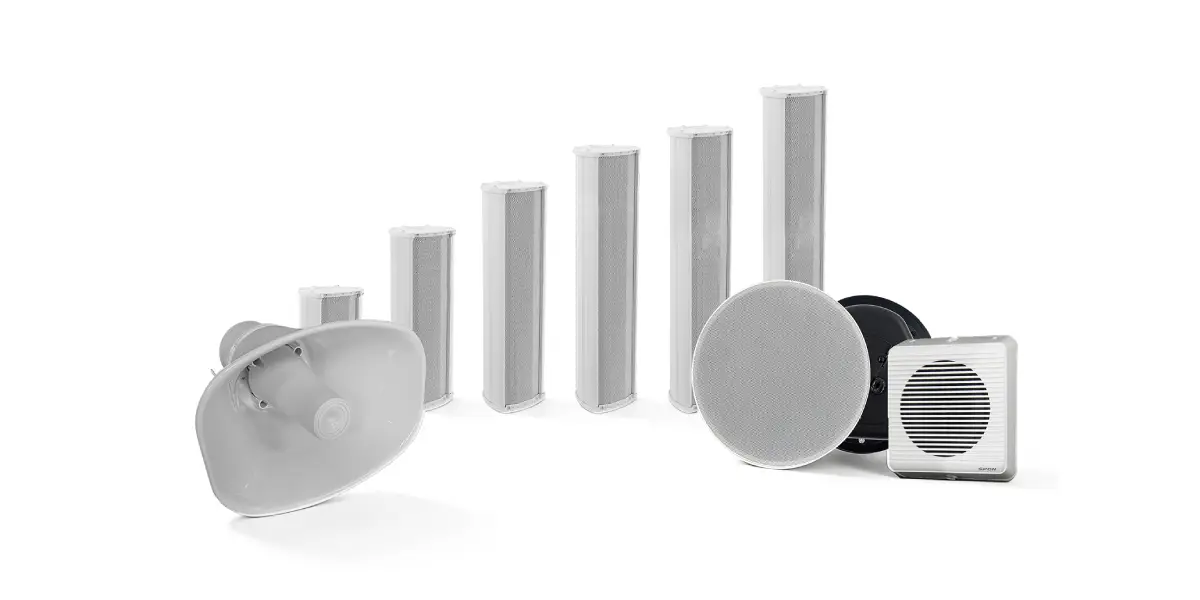
Every B2B PA installation uses one or more of these six speaker categories. The selection depends on the acoustic environment, the required coverage area, and the integration architecture.
Speaker Type Power Source Best B2B Use Case Key Technical Trait
Passive PA Speaker External amplifier required Installed venues, large facilities with central amp rooms 8Ω / 16Ω impedance; amp power must be 2× RMS rating for headroom
Active Speaker Built-in Class D amplifier Events, portable deployments, conference rooms, retail Self-contained; matched amp ensures optimal driver performance
IP PoE Speaker PoE via single Ethernet cable Smart buildings, campuses, hospitals, multi-zone networks SIP + RTP/multicast; individually addressed; remote-managed
70V / 100V Line Constant-voltage amplifier Large-scale installs: airports, factories, shopping centres Multiple speakers daisy-chained; impedance-independent wiring
IP Horn Speaker PoE or local power; IP66 rated Outdoor: playgrounds, car parks, industrial yards, sports fields High SPL (110–121 dB); wide dispersion; weatherproof
Column / Array Speaker External amp or active variants Auditoriums, lecture halls, transit hubs, reverberant spaces Narrow vertical dispersion reduces reverberation; long throw

Passive PA Speakers

Passive speakers have no internal amplifier. They receive a pre-amplified signal from an external power amplifier and convert it to sound. In B2B contexts, passive speakers are common in large permanent installations — auditoriums, transportation hubs, industrial facilities — where a central amplifier drives multiple speakers from one rack-mounted unit. The amplifier can be located in a climate-controlled equipment room, extending its lifespan significantly compared to built-in electronics exposed to stage or ambient conditions.The key engineering discipline with passive speakers is impedance matching. The total load impedance presented by the speaker array must fall within the amplifier's rated range. Mismatched impedance is responsible for an estimated 60% of passive speaker failures in commercial installations, according to industry fault-analysis data. For 70V/100V constant-voltage systems — the standard in commercial PA — speakers connect in parallel across the transformer line, and impedance matching is handled by the transformer tap setting on each speaker.

Active PA Speakers

Active speakers integrate the power amplifier and speaker drivers into a single enclosure. The amplifier is factory-matched to the specific drivers, ensuring the optimal power delivery and crossover alignment without requiring any external configuration. This makes active speakers significantly faster to deploy and eliminates the risk of amplifier-speaker mismatch — a common failure mode in passive systems.For B2B applications involving portable deployments — conference events, trade shows, retail activations, outdoor pop-ups — active speakers are almost always the right choice. They arrive as a self-contained unit, require only a power source and a signal input, and can be operational in minutes. Modern active PA speakers include built-in DSP (digital signal processing) for equalization, limiting, and feedback suppression, features that previously required separate rack-mounted processors.

IP PoE Speakers

IP PoE (Power over Ethernet) speakers represent the most significant shift in B2B PA speaker technology over the past decade. These are network-connected speakers that receive audio data and electrical power through a single standard Ethernet cable from a PoE-capable network switch.Each IP speaker is assigned a unique IP address and communicates using SIP (Session Initiation Protocol) and RTP (Real-time Transport Protocol) — the same protocols that underpin VoIP phone systems. Audio delivery uses either unicast (one stream to one speaker) or multicast (one stream to many speakers simultaneously), with multicast being the standard for campus-wide broadcasts. Multicast transmission is highly bandwidth-efficient — a single audio stream serves hundreds of endpoints simultaneously without multiplying network load.For B2B buyers, the IP PoE speaker changes the total cost model of a PA installation. There is no dedicated speaker cable infrastructure to plan, run, or maintain. Speakers can be added anywhere the network reaches — including portable classrooms, remote buildings, and newly constructed wings — without new cable runs. Zone management is handled entirely in software. And every speaker's health, volume level, and operational status is visible in a central management dashboard.IP PoE speakers can integrate with many modern communication and security platforms, including SIP-based VoIP phone systems such as Cisco, Microsoft Teams, Zoom Phone. Some advanced systems also support ONVIF-compatible CCTV platforms, fire alarm systems, access control systems, and mass notification software.This integration allows a single IP network to handle voice communication, public address paging, video monitoring, and emergency alerts together. In modern smart buildings, this centralized and network-based approach improves system management, simplifies expansion, and reduces infrastructure complexity compared to traditional standalone systems.

70V / 100V Constant-Voltage Speakers

The 70V (North America) and 100V (Europe/international) constant-voltage standard has been the backbone of commercial PA installations for decades. In this architecture, a constant-voltage amplifier outputs audio at a standardised high voltage (70.7V or 100V peak), and each speaker includes a step-down transformer that converts this to the appropriate drive level for its driver.The practical advantage: speakers can be connected in parallel across the transmission line without impedance calculation, and cable can run hundreds of metres from the amplifier without significant signal loss. This makes 70V/100V systems highly cost-effective for large-scale installations with many distributed speakers — airports, shopping centres, hospitals, factories — where running individual amplifier feeds to each speaker would be impractical.The limitation: volume control at the individual speaker level requires an impedance-friendly volume control or a separate addressable tap system. Modern IP-70V hybrid systems bridge this gap by using an IP audio controller to manage zone routing and volume in software, while retaining the 70V transmission architecture to the speakers themselves.

Horn Speakers

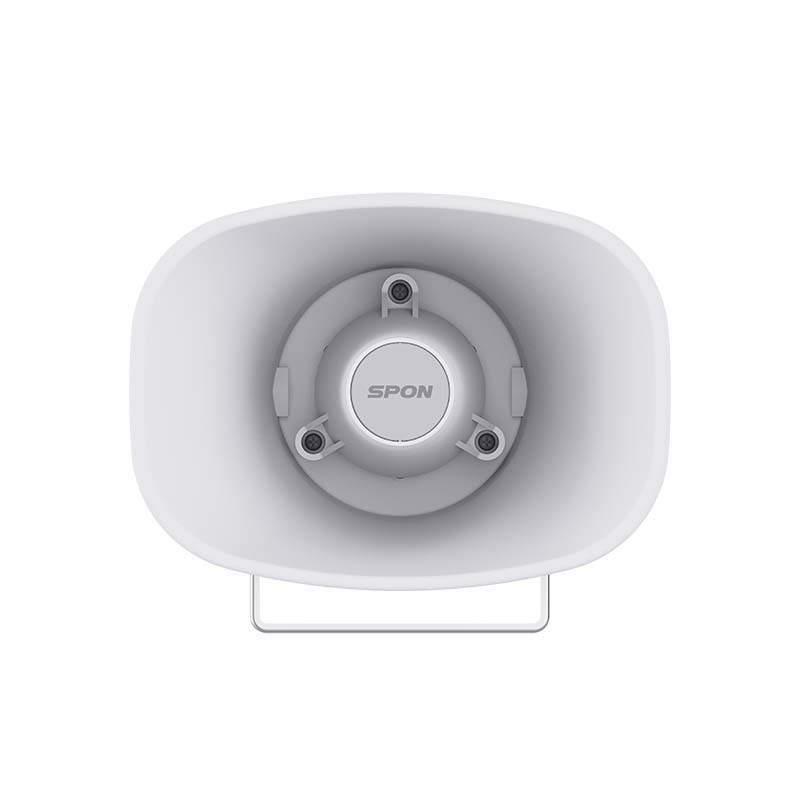
Horn speakers use a compression driver coupled to a horn-shaped acoustic transformer that efficiently projects sound over long distances. In B2B PA applications, they are the standard for outdoor environments: school playgrounds, factory yards, sports facilities, car parks, rail platforms, and construction sites.The acoustic efficiency of horn speakers is substantially higher than conventional cone speakers — typically 97–105 dB sensitivity, versus 85–92 dB for a standard PA cabinet. This translates to achieving the required SPL at longer distances with lower amplifier power. IP PoE horn speakers combine this acoustic efficiency with network connectivity and IP66 weatherproofing, delivering a single-cable outdoor audio endpoint that can be remotely managed alongside indoor IP speakers on the same platform.

Column and Line-Array Speakers

Column speakers use a vertical array of multiple driver elements to create a controlled, narrow vertical dispersion pattern. Where a conventional speaker sends sound in a wide sphere — bouncing off ceilings and floors and creating reverberation — a column speaker sends it horizontally, directly at the audience plane. In acoustically challenging spaces (high ceilings, parallel hard walls, stone or tile floors), this dramatically improves speech intelligibility.In B2B terms, column speakers are the correct specification for transit concourses, airport terminals, lecture theatres, houses of worship, and any large open space where reverberation is a persistent problem. They cost more per unit than conventional ceiling or wall speakers, but in spaces where intelligibility is critical — emergency announcements, flight boarding calls, legal proceedings — they deliver measurably better results.

Active vs Passive PA Speakers

This is the most common specification question B2B buyers face when designing a PA installation. The answer depends on the deployment scenario, the scale of the installation, and the technical capabilities of the team managing it.
Decision Factor Active (Powered) Speaker Passive + External Amp
Setup complexity Plug in power + signal — done in minutes Requires amp, speaker cable, impedance matching — more expertise
System scalability Each unit is self-contained; easy to add Single amplifier drives multiple speakers — lower per-speaker cost at scale
Component failure Whole unit must be replaced or serviced Replace only the failed component — driver, amp, or cable
Audio optimization Built-in DSP ensures factory-matched amp-driver pairing Flexible: upgrade amp or speakers independently for best performance
Permanent installs Works well; slightly higher unit cost Cost-effective for large fixed arrays; amp in climate-controlled room
Portable / events Ideal — self-contained, fast setup, no amp transport Less practical — adds weight and setup time in temporary deployments
Budget sensitivity Higher per-unit cost; lower total system complexity cost Lower hardware cost; higher installation and expertise cost

The 6 Specifications That Matter Most for B2B Buyers

PA speaker datasheets contain many numbers. These six are the ones that determine whether a speaker actually performs in a real commercial or institutional environment.
Specification What It Means What B2B Buyers Should Focus On Common Mistake
RMS Power (W) Continuous power handling capability Match RMS power to room size, ceiling height, and ambient noise level Comparing peak power ratings instead of RMS ratings
SPL (dB) Maximum sound output level Use higher SPL speakers for factories, outdoor areas, and noisy spaces Ignoring background noise when calculating coverage
Frequency Response Audio range the speaker can reproduce 80 Hz–16 kHz works well for voice and background music; speech-only systems may require less range Choosing narrow-range speakers for multimedia applications
Impedance (Ω) Electrical load for passive speakers Ensure amplifier and speaker impedance are properly matched Connecting multiple speakers without calculating total load impedance
IP Rating Protection against dust and water IP65 minimum for outdoor use; IP66 recommended for harsh environments Using indoor-rated speakers outdoors
Dispersion Angle How sound spreads across an area Wide dispersion for ceiling coverage; narrow dispersion for long-distance projection Using narrow-coverage speakers in wide seating areas


For B2B buyers evaluating IP PA speakers for the first time, the technology can seem more complex than it is. Here is a clear, jargon-minimised explanation of how these systems work.An IP PA speaker is a network endpoint. It connects to the facility's existing LAN (Local Area Network) via a standard Ethernet cable. If the network switch supports PoE (Power over Ethernet, IEEE 802.3af for standard PoE, 802.3at for PoE+), the same cable that delivers network connectivity also delivers power to the speaker — no separate electrical outlet is needed.Audio is transmitted over the network using two standard internet protocols:
  • SIP (Session Initiation Protocol): handles the call signalling — who is paging, which zones should receive the audio, and what priority the broadcast has. SIP is the same protocol used by VoIP phones, which is why IP PA speakers can be registered as extensions on an existing VoIP phone system. Any authorised phone on the network can initiate a page to any zone.
  • RTP (Real-Time Transport Protocol): carries the actual audio data in small digital packets. In a multi-speaker deployment, audio is typically sent as multicast — a single RTP stream that all subscribed speakers receive simultaneously — rather than unicast (individual streams to each speaker), which would multiply bandwidth usage.
At the management layer, IP PA speakers support ONVIF (Open Network Video Interface Forum) — the same interoperability standard used by IP cameras. This allows IP speakers to be managed alongside CCTV cameras in a unified Video Management System (VMS), triggering audio responses based on camera-detected events: motion in a restricted zone after hours, detected acoustic anomalies (raised voices, breaking glass), or automated safety announcements when specific areas are occupied.

PA Speakers by Industry: B2B Use Case and Specification Matrix

The right PA speaker specification varies significantly by industry vertical. The table below maps each key B2B sector to its recommended speaker type, integration requirements, and primary performance criteria.
Industry Recommended Speaker Key Integration Primary Requirement
K-12 Schools IP PoE Ceiling + IP Horn (outdoor) Fire alarm, panic alert, VoIP Multi-zone bells, emergency override, Alyssa's Law compliance
Hospitals & Clinics IP PoE Ceiling + Display Speaker Nurse call, fire alarm, access control Low-volume paging, code alert, visual notification for hearing-impaired
Retail & Shopping Ceiling (indoor) + Horn (outdoor) BGM system, POS events, CCTV Zone BGM, promotional announcements, emergency evacuation audio
Factories & Warehouses IP Horn + 70V Wall Speaker Machine alarm, ERP, fire alarm High SPL to overcome 80–100 dB ambient noise; safety broadcast
Hotels & Hospitality Ceiling + In-ceiling (stylised) PMS, fire alarm, BGM zones Discreet aesthetics, multi-zone BGM, emergency compliance
Airports & Transit Column Array + Horn (outdoor zones) SCADA, flight info, emergency High speech intelligibility in reverberant, noisy concourse spaces
Corporate Offices IP PoE Ceiling UCaaS (Teams/Zoom), VoIP PBX SIP/multicast paging from existing phone platform, meeting room alerts

PA Speaker Procurement: A B2B Buyer's Checklist

Before issuing any RFQ or engaging a vendor, work through this checklist. The answers to these questions determine the specification before a single product datasheet is opened.
  • 1. What is the ambient noise level in each coverage zone? Measure it, or use published benchmarks for your sector. This single figure determines the minimum SPL requirement and rules out entire speaker categories for high-noise environments.
  • 2. Is the coverage requirement indoor, outdoor, or both? Indoor environments may use standard IP65-unrated speakers. Any outdoor speaker must be IP65 or higher. Confirm whether any locations require IP66 or salt-resistant treatment.
  • 3. What is the existing network infrastructure? Confirm whether Cat5e or Cat6 Ethernet is in place and whether PoE or PoE+ is available from the network switches. If not, calculate the cost of switch upgrades versus dedicated speaker cable runs.
  • 4. What integrations are required? List every system the PA speakers must connect to: VoIP PBX or UCaaS platform, fire alarm panel, access control system, CCTV/VMS, panic alert platform, background music system, or mass notification software. Each integration requirement may affect protocol support (SIP, multicast, ONVIF, relay contact) and may rule out certain product categories.
  • 5. What are the compliance and regulatory obligations? Identify any applicable standards: EN 54 (Europe fire alarm audio), NFPA 72 (US fire alarm and mass notification), Alyssa's Law (US school panic alert, 11 states), ADA/Equality Act accessibility requirements for visual notification in hearing-impaired accessible spaces.
  • 6. What is the coverage zone architecture? Map every space that requires audio coverage. Identify ceiling heights, acoustic surface materials, room dimensions, and any irregular geometries. Calculate the number and placement of speakers required per zone before specifying power and quantity.
  • 7. Who manages and maintains the system after installation? IP-based systems require IT network access and software management skills. Analog 70V systems require audio engineering knowledge. Confirm whether in-house skills support the chosen architecture, or whether a managed service model is required.

Conclusion

The best PA speaker solution depends on the acoustic environment, system size, and integration requirements.For modern smart buildings, IP PoE speakers provide flexible management, software-based zone control, and easy integration with VoIP and emergency systems. They are becoming the mainstream choice and future trend in commercial audio systems.This blog provides a comprehensive introduction to PA speakers and related technologies. If you have any questions or project requirements, feel free to contact SPON. Our professional technical team is ready to provide expert support and tailored solutions for your project.
FAQS
Q1: What does PoE mean for a PA speaker?
PoE stands for Power over Ethernet. It allows an IP speaker to receive both power and audio data through a single Ethernet cable. This reduces wiring complexity and installation cost.
Q2: What is the difference between SIP paging and multicast audio?
SIP paging works like a phone call to specific speakers or zones. Multicast sends one audio stream to many speakers at the same time, making it ideal for large-scale announcements and school bell systems.
Q3: What IP rating is recommended for outdoor PA speakers?
IP65 is the minimum recommendation for most outdoor environments. For coastal, industrial, or wash-down areas, IP66 is recommended for better water protection.
Q4: How do PA speakers integrate with fire alarm systems?
When a fire alarm is triggered, the PA system can automatically override normal audio and play emergency evacuation messages. IP systems can also support software-based emergency broadcasting and zone control.