


 2025-01-24
 Author: cora
 Page view: 6757
A power amplifier, referred to as an amp, is an electronic device used to enhance the power of an audio signal. It amplifies weak electrical signals from a signal source (input device) to a level that can drive speakers. Audio amplifiers are most commonly found in public address systems and concert equipment.

• Input signal: The amplifier receives a weak audio signal, like audio source.
• Amplification: A power amplifier boosts the amplitude of a signal without changing its frequency or other characteristics.
• Output signal: The amplified signal is sent to speakers to make the sound louder.
Amplifiers are usually categorized into four types, Class A, Class B, Class AB, and Class D, depending on the conductivity of the amplifier tubes.
1.Class A Power Amplifier
Class A amplifiers are the most traditional type of power amplifier. The output transistor conducts for the entire signal cycle (360°), which means that the transistor is always active and always amplifies the input signal.
Class A amplifiers operate in a very linear manner and have a simple circuit design. It is able to accurately amplify the input signal and maintain the original characteristics of the signal.
Advantages:
• Excellent sound quality: high linearity with minimal distortion.
• Simple design: the circuit structure is straightforward, stable and reliable.
Disadvantages:
• Low efficiency: efficiency is usually only 20%-30%.
• High heat generation: most of the energy is converted into heat.
• Limited power: suitable for low power amplification, unable to meet high power requirements.

2.Class B Power Amplifier
A Class B amplifier works by using two output transistors. Each transistor conducts for only half of the input signal cycle (180°). One transistor amplifies the positive half of the signal, and the other amplifies the negative half.
Since each transistor is on for half the time, it avoids wasting energy like Class A amplifiers do, where the transistors are always on.
Advantages:
• Class B amplifiers are usually 60%-70% efficient, much better than the low efficiency of Class A amplifiers.
• They produce less heat since the transistors are not always on, meaning they don't need as much cooling.
Disadvantages:
• Crossover distortion: When the signal switches from one transistor to the other, some distortion can happen, which can affect sound quality.
• Complex design: The amplifier requires careful adjustments to ensure minimal distortion and stable operation.

3.Class AB Power Amplifier
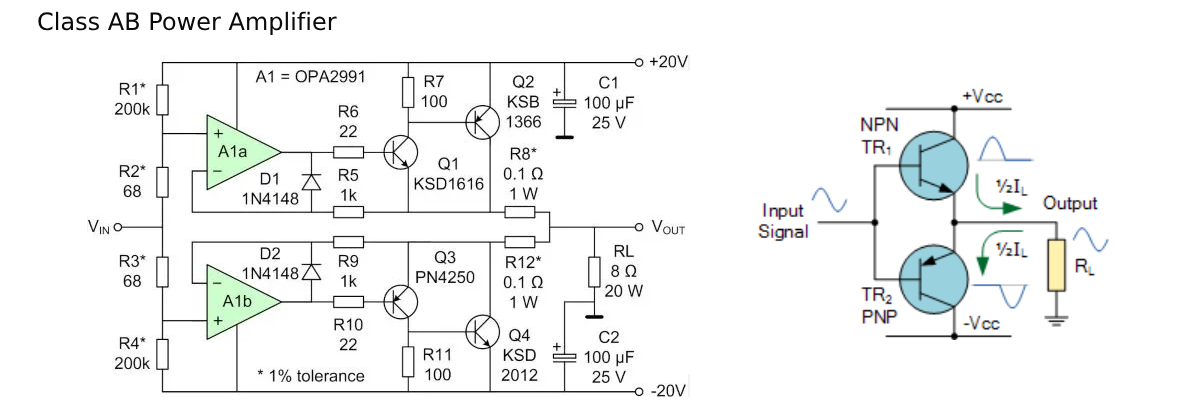
A Class AB amplifier combines the best parts of Class A and Class B amplifiers. It allows each output transistor to work for more than half of the signal cycle, but not the full cycle (usually 180-200 degrees). This helps reduce the crossover distortion found in Class B amplifiers, while also improving the efficiency of Class A amplifiers. In a Class AB amplifier, both output transistors work at the same time, providing better performance overall.
Both transistors will operate simultaneously, covering the entire signal cycle, but with a slight overlap in the operating time of each transistor. This maintains better sound quality and increases efficiency.
Advantages:
• Higher sound quality: the crossover distortion of Class B is reduced and the sound quality is closer to that of Class A.
• Higher efficiency: Better efficiency than Class A.
• Less heat: less heat than Class A.
Disadvantages:
• Still generates heat: more efficient, but still generates more heat than Class B.
• More complex circuitry: requires more regulation and design than Class A and Class B. More complex circuitry.
4.Class D Power Amplifier Classes
A Class D amplifier is a type of amplifier that uses switching technology. It's also called a "digital amplifier" Instead of amplifying the signal in a straight line, it works by quickly switching the output transistors on and off (fully on or fully off). The input audio signal is changed into a high-frequency square wave, which passes through a low-pass filter to produce an amplified audio signal.
Advantages:
• Very high efficiency: the efficiency of Class D amplifier can reach 80%-90%, which reduces energy waste.
• Small size and light weight: suitable for portable audio or other devices that require space saving.
• Generates less heat: due to its high efficiency, it generates less heat and therefore does not require a complex cooling system.
Disadvantages:
• Slightly poorer sound quality: due to its switching principle of operation, Class D amplifiers may introduce some high-frequency noise and distortion, which can somewhat affect sound quality.
• Complex circuit design: Complex modulation techniques and filters are required to minimize noise and distortion, and the circuit design is more complex than traditional Class A or Class B.
#Classification2
According to the number of amplifying in the output stage of the amplifier, it can be divided into single-ended amplifier and push-pull amplifier.
1.Single-Ended Amplifier
A single-ended amplifier is a device that uses a transistor or other amplifying element to make a signal stronger and then send it through an output transformer or load resistor to a speaker or other load. This design is simple and usually works well with low power.
- Simple design and low cost.
- Suitable for low-power applications with cleaner sound quality.
- Low efficiency, higher heat generation and limited power output.
2.Push-Pull Amplifier
Push-pull amplifiers use two transistors. One transistor amplifies the positive half-wave signal, and the other amplifies the negative half-wave signal. This way, the two transistors work one after the other, which reduces distortion and increases efficiency.
- High efficiency and high power output.
- Can effectively reduce distortion, better sound quality.
- Circuit design is complex and costly.

#Classification3
Power amplifiers can be divided into tube amplifiers and solid-state amplifiers based on the type of amplifier tube used.
1. Tube Amplifier
A tube amplifier uses electronic tubes to amplify sound. It has a very warm, soft sound quality that many audiophiles enjoy. However, tube amplifiers generate more heat, are less efficient and larger, and usually require better heat dissipation and maintenance.
2. Solid-State Amplifier
Solid-State Amplifier uses transistors to amplify the sound, which is more efficient, smaller, and generates less heat. Although its sound quality is clearer and more precise, its tone is a bit colder and not as warm compared to that of a gallows. Because of its high efficiency and durability, the stone machine has become a more common choice in modern audio equipment.
#Classification4
According to different functions, it can be preamplifier, power amplifier and integrated amplifier.
1. Pre-Amplifier
A pre-amplifier makes weak signals (like from a mic or guitar) stronger so that they can be processed by the rest of the system.
2. Power Amplifier
A power amplifier makes the signal loud enough to drive the speakers. It makes the sound loud enough for you to hear it clearly at higher volumes.
3. Integrated Amplifier
An integrated amplifier combines the pre-amp and power amp into one unit. It makes the signal loud enough for the speakers.
#Classification5
According to different uses, it can be divided into AV amplifier and Hi-Fi amplifier.
1. AV Amplifier
AV amplifiers are designed for home theaters. They usually have at least 4 channels and surround sound decoding, plus a display screen. These amplifiers make movies sound realistic, so you feel like you're at the cinema.
2.Hi-Fi Amplifier
Hi-Fi amplifiers are made to play music as accurately as possible. They are usually two-channel amplifiers and don't have a display screen. They're designed to play music with high fidelity, meaning they'll produce sound that closely resembles the original recording.

♦ Output Power: This is the maximum power an amplifier can deliver to the speakers without causing significant distortion. It determines how loud the amplifier can drive the speakers at a given time.
♦ Peak Power: This is the maximum instantaneous power the amplifier can provide, typically for very short durations. It’s crucial for handling sudden loud sounds in music or movies without clipping or damaging the amplifier.
♦ Rated Output Power: The continuous power the amplifier can output under standard operating conditions (without overheating or damaging the components). This is usually given as a constant value (e.g., 100W) for continuous sound reproduction.
♦ Frequency Response: This refers to the range of audio frequencies (measured in Hz) the amplifier can effectively amplify without significant attenuation or distortion. A wider frequency response (e.g., 20Hz to 20kHz) ensures more accurate reproduction of sound.
♦ Distortion: Distortion measures how much the amplified signal deviates from the original signal. It’s usually expressed as Total Harmonic Distortion (THD), where a lower percentage indicates cleaner, more faithful sound reproduction.
♦ Signal-to-Noise Ratio (SNR): This measures the level of the desired signal compared to unwanted background noise. A higher SNR (measured in dB) means the amplifier produces clearer sound with less hiss or hum.
♦ Output Impedance: The output impedance affects how well the amplifier drives different speakers. It interacts with the speaker’s impedance to ensure efficient power transfer and proper performance. A mismatch in impedance can cause reduced sound quality or damage.
♦ Slew Rate: The slew rate is how quickly the amplifier can change its output voltage in response to fast changes in the audio signal. A higher slew rate allows the amplifier to handle fast transients (like drum hits or sharp sound changes) without distorting or clipping the signal.
Power amplifiers play a key role in boosting low-frequency audio signals to power speakers and headphones. These include types like Class D, single-ended, preamplifiers, and hybrid amplifiers, each with its own pros and cons. When choosing the right amplifier, it's important to consider factors such as power output, efficiency, distortion, and frequency response. Understanding these features will help you select the best amplifier for your needs.
Reference:
testbook: https://testbook.com/electrical-engineering/power-amplifier-definition-types-and-uses
electronicshub: https://www.electronicshub.org/power-amplifier/
etechsparks: https://etechsparks.com/fundamentals-of-the-class-b-power-amplifier/
wikipedia: https://en.wikipedia.org/wiki/Audio_power_amplifier


 AR
AR
 EN
EN


