School Bell & Alert Lockdown Systems: UK Campus Safety 2026
Imagine this: Tuesday morning. Classes are underway, corridors are quiet, and staff are focused on teaching. Then an unknown person enters the grounds.What happens next depends entirely on your communication system.
In UK schools today, the difference between panic and a calm, coordinated response often comes down to one thing: a reliable school lockdown audio system that tells the right people the right thing, in the right place, in seconds.That's not an exaggeration. Research by software company Little Green Button involving more than 1,200 education professionals found that 44% were unfamiliar with Martyn's Law, and more than half felt their school was not ready to manage a lockdown or major security incident. Meanwhile, the global school security market reached USD 3.87 billion in 2024 and is forecast to grow at 8.3% annually through 2033, driven by rising safety concerns and tighter government regulation.
The message is clear: modern schools need modern audio alert systems — and they need them now.This blog walks you through everything you need to know about school bell and alert lockdown systems.
What Is Martyn's Law ?
Martyn's Law — formally the Terrorism (Protection of Premises) Act 2025 — became law on 3 April 2025. It is named in memory of Martyn Hett, one of the 22 people killed in the 2017 Manchester Arena bombing.All UK schools, including early years, primary, secondary and further education settings, are classed as 'standard tier' premises and have two years to prepare before enforcement begins in 2027.The law outlines four types of procedures that every school must have in place: evacuation (moving people out safely), invacuation (moving people to safer internal areas), lockdown (securing the site by locking doors and restricting movement), and communication — alerting everyone on site that there is danger.However, many schools still feel unprepared for major security incidents, and limited budgets remain a major challenge.Although the law does not require a dedicated lockdown alarm system, schools are still responsible for proving they can communicate quickly and clearly during emergencies.That is why many schools are upgrading to dedicated school lockdown audio systems. These systems provide fast emergency alerts, clear voice instructions, and documented safety procedures to help schools improve campus security and meet Martyn’s Law requirements.
The Problem With Using a Fire Alarm for Lockdown
Fire alarms are designed for one instruction only: get out now. If your school uses the same alarm — or a variation of the same sound — for both a fire evacuation and a security lockdown, you are creating a serious risk.The National Counter Terrorism Security Office (NaCTSO) specifically advises against using fire alarms during lockdown events.Here is why it matters:1. It sends people in the wrong direction. During a fire, you evacuate. During a lockdown, you stay inside and secure the room. If staff or students hear a familiar alarm and instinctively start moving toward exits, they could walk directly toward a threat.2. It creates confusion across the site. Some staff may evacuate while others lock down, creating conflicting actions that slow response time and increase risk.
3. It removes context entirely. A pre-recorded voice message saying "Lockdown. Secure doors and stay out of sight. Await further instruction." is infinitely clearer than a siren pattern that requires interpretation.
What Is a School Lockdown Audio System?
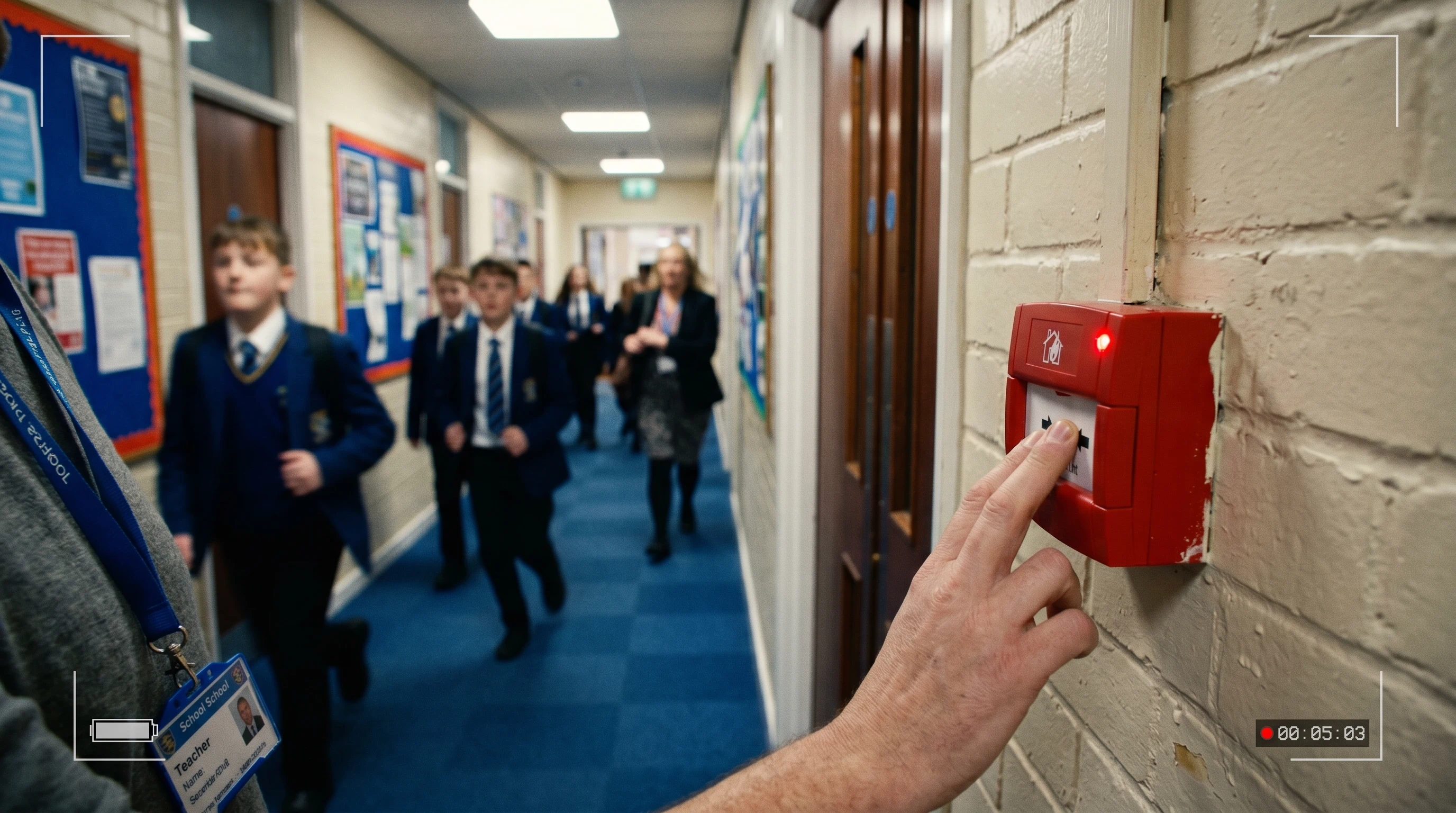
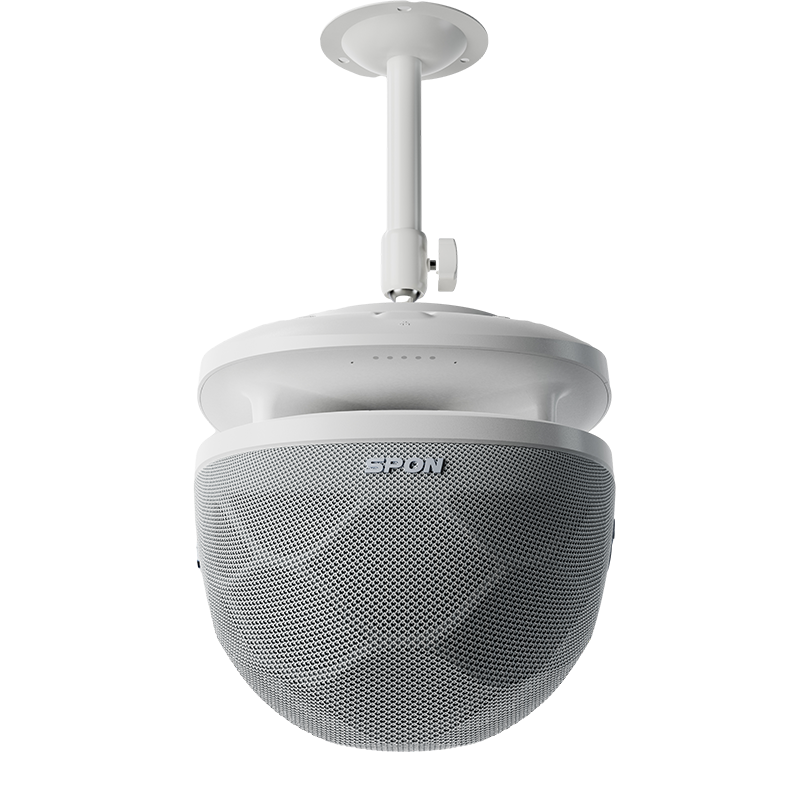
A school lockdown audio system is a dedicated emergency communication platform that allows authorised staff to instantly broadcast clear audio (and sometimes visual) alerts to every part of a school premises — classrooms, corridors, outdoor areas, sports halls, and car parks.Modern systems go far beyond a simple siren. They typically include:1. Voice messaging: Pre-recorded voice instructions broadcast in calm, clear language across all zones simultaneously. Staff don't need to think — the message does the work.2. Zoned control: Alerts can be targeted to specific blocks, floors, or areas. You can trigger a lockdown in one building while leaving the rest of the school operating normally.3. Multiple activation methods: Panic buttons (wall-mounted or portable), mobile apps, VoIP phones, laptops, or tablets. Any authorised staff member can trigger the system from wherever they are on site.4. Integration with existing infrastructure: Speakers, strobe lights, digital signage, access control systems, and CCTV can all be connected to the lockdown system for a coordinated response.5. Audit trails: Every activation is automatically logged, creating a timestamped digital record that school leadership and safeguarding teams can review after any incident or drill.
School Bell & Alert Lockdown Systems: One Platform, Two Jobs
The most efficient approach for schools is a system that handles both the day-to-day bell schedule and emergency lockdown alerts from the same platform.Modern school bell and alert lockdown systems do exactly that. During a normal school day, the system plays scheduled bells, tones, or music to signal class changes, break times, and the start and end of the day. In an emergency, the same infrastructure instantly switches to broadcast lockdown or evacuation alerts.This approach offers real advantages:1. Familiarity breeds speed. When staff interact with the alert system every day, they're confident using it in a real emergency. There's no learning curve under pressure.2. Cost efficiency. Rather than running a separate bell timing system and a separate emergency alert system, one integrated platform covers both.3. Flexibility. You can play different tones, melodies, or voice recordings for different events — class change, fire drill, invacuation, lockdown, or all-clear. This removes any ambiguity about which emergency is being communicated.
4.SEND awareness. Combining audio alerts with flashing strobes and visual displays ensures that students and staff with hearing impairments receive the same information as everyone else.
What Is a SIP Paging System — and How Does It Work in UK Schools?
SIP stands for Session Initiation Protocol. It is the same technology that powers most modern VoIP phone systems. A SIP paging system uses your school's existing IP network to transmit live or pre-recorded audio to speakers anywhere on the network — without the need for separate analogue cabling.In the UK, SIP paging systems are increasingly popular in schools because they integrate seamlessly with existing phone infrastructure, are straightforward to manage, and offer significant cost savings over traditional 100V line PA systems.How a SIP Paging System Works in Practice1. An authorised user triggers a page — either by dialling a paging group from a VoIP phone, pressing a wall-mounted call point, or using a software interface on a PC or mobile device.2. The SIP paging gateway (a compact hardware device connected to the network) receives the SIP call and converts the audio signal to a network stream.3. IP speakers throughout the building receive the stream and broadcast the audio simultaneously, with no perceptible delay.4. The system logs the event and, where configured, can trigger secondary actions such as door lock activation, CCTV recording, or email alerts to designated staff.
Key Features of SIP Paging Systems for Schools
PoE (Power over Ethernet): Most modern SIP speakers and gateways are powered directly through the ethernet cable, eliminating the need for separate power supplies and making installation clean and simple.Multi-zone broadcasting: Different messages can be sent to different zones simultaneously — for example, a lockdown alert to the main building while a separate all-clear plays in an already-secured wing.HD audio quality: Modern SIP paging gateways support wideband codecs such as G.722, delivering crystal-clear audio that is easy to understand even in noisy environments like sports halls or kitchens.Offline local broadcast: Devices with USB or SD card storage can play pre-recorded messages even if the network goes down during an incident — a critical failsafe for emergency scenarios.Compatibility with major platforms: Leading SIP paging gateways are compatible with platforms including 3CX, Asterisk, Avaya, BroadSoft, and Metaswitch, making them easy to integrate into a school's existing telephony environment.For UK schools running 3CX phone systems — which is extremely common — a SIP paging gateway can be configured in minutes, allowing any authorised phone extension to broadcast a page to the whole school or to selected zones.
UK IP Audio for CCTV Integration: Why Audio and Video Belong Together
Most school CCTV systems today record what they see. But what about what they hear?IP audio for CCTV integration takes your security system from passive to proactive. When your IP speakers and microphones connect to your IP camera network — managed through a unified Video Management System (VMS) — the result is a security platform that can see, hear, and respond.What IP Audio Adds to a CCTV System:Automated audio responses: When an IP camera detects motion in a restricted area after hours, it can automatically trigger a pre-recorded warning message through a nearby IP speaker: "This area is monitored. Please leave immediately." This happens without any human intervention.Two-way communication: With two-way audio-enabled cameras or intercom units, a staff member in the school office can speak directly to a visitor at the gate, a student in a corridor, or security personnel on the grounds — without leaving their desk.Audio event detection: Advanced AI-enabled cameras can analyse sound patterns to detect specific events — raised voices, breaking glass, or other acoustic anomalies — and trigger alerts before the incident becomes visible on screen. This means security teams are notified earlier, giving them more time to respond.ONVIF integration: The ONVIF standard (Open Network Video Interface Forum) allows audio devices from different manufacturers to communicate with VMS platforms. A school can mix and match cameras, speakers, intercoms, and access control devices from different vendors and manage them all from one system.Evidential recording: Audio captured alongside video footage during an incident provides much richer evidence for investigations, insurance claims, or police reports.
UK-Specific Considerations for IP Audio and CCTV
In the UK, audio recording in schools is subject to GDPR and the Data Protection Act 2018. Schools must ensure that:-Audio recording is proportionate and justified by a legitimate security purpose-Staff, students, and visitors are informed about recording via appropriate signage and privacy notices-Recorded audio is stored securely, accessed only by authorised personnel, and retained only as long as necessaryIP audio systems that integrate with CCTV typically offer access control features, audit logs, and configurable retention periods — making GDPR compliance far more manageable than with older analogue solutions.
How These Systems Work Together: A Complete School Safety Ecosystem
The real power comes from integration. Here is what a fully connected school safety audio system looks like in practice:Day-to-day: The IP-based bell system plays scheduled tones and voice announcements across all zones at pre-set times. Staff use the SIP paging system to make PA announcements from any phone or device. CCTV cameras with two-way audio allow gate staff to verify visitors before granting access.Intruder alert: A staff member spots a suspicious individual on site and activates the lockdown via a wall-mounted panic button or mobile app. Instantly, the lockdown audio system broadcasts a distinct pre-recorded voice message to all zones. CCTV begins recording all cameras simultaneously. Access control locks all entry points. A digital alert appears on every classroom screen. An SMS notification goes to off-site senior leadership. The entire sequence happens in under ten seconds.All clear: When the threat has passed, an authorised member of staff broadcasts the all-clear message from any approved device. The system logs the full timeline — activation time, message content, zones reached, and staff acknowledgements — for the post-incident report required under Martyn's Law protocols.
Conclusion
A modern School Lockdown Audio System does much more than deliver emergency alerts. It combines daily school bells, SIP paging, lockdown notifications, and IP audio into one unified platform.As schools across the UK strengthen their security measures, integrated School Bell & Alert Lockdown Systems are becoming an essential part of campus safety. Connected with CCTV, access control, and SIP phones, these systems help schools communicate quickly and effectively during both everyday operations and emergencies.The question is not whether your school needs a lockdown communication system—it's how soon you can put one in place.
Looking for a school bell system, lockdown alert system, SIP paging solution, or IP audio platform for your school?Contact SPON today for a free system design and consultation.

FAQS
Q1: Does Martyn's Law require schools to install a lockdown alarm system? 

Not explicitly. The Act is outcomes-focused and does not mandate specific hardware. However, schools must be able to clearly communicate their lockdown procedures to all staff, students, and visitors quickly and effectively. A dedicated lockdown audio system with voice messaging is the most practical and reliable way to achieve this — and to evidence it for the SIA when required.
Q2: Can schools use their existing PA system for lockdown alerts?
Yes, if the system supports clearly distinguishable lockdown signals and can be activated quickly from multiple points. Many schools use SIP paging gateways to add lockdown capability to an existing PA infrastructure at relatively low cost.
Q3: What is the difference between invacuation and lockdown?
Invacuation means moving people from outdoor or exposed areas into a safe internal space — for example, bringing students in from the playground when a threat is nearby but outside the building. Lockdown means securing people in place — doors locked, out of sight, low profile — until an all-clear is issued. Both require distinct, unambiguous audio alerts.
Q4: How does IP audio for CCTV integration help during a lockdown?
When your IP audio and CCTV systems are integrated, a lockdown trigger can simultaneously broadcast audio alerts, activate camera recording across all feeds, lock access control points, and push alerts to staff devices. The unified response is far faster and more coordinated than operating each system separately.
Q5: Is IP audio recording in schools legal in the UK?
Yes, provided it is proportionate, disclosed to staff and students, and handled in accordance with GDPR and the Data Protection Act 2018. Schools should include audio surveillance in their privacy notices and ensure that recorded data is stored securely with appropriate retention policies.



 2026-05-21
 Author: SPON
 Page view: 805



 AR
AR
 EN
EN
.png)


