


 2025-11-07
 Author: cora
 Page view: 8252
Did you know? According to Grand View Research, the global professional audio equipment market was about USD 19.1 billion in 2023, and it is expected to keep growing from 2024 to 2030.
A speaker box looks simple on the outside, but the internal structure is not random. Different enclosure designs will change bass strength, voice clarity, and coverage range. This article will explain basic speaker knowledge, the main parts, and 7 common speaker enclosure types in a simple way. We hope this guide is helpful for you.
1. Speaker overview
A speaker is a device that turns an audio signal into sound and makes the sound louder.
A speaker is the end point of the whole audio system. Its job is to convert electrical energy into sound energy, and send it into the space for people to listen.
2. How a speaker works
Medium for sound
To understand how a speaker makes sound, we first need to know how sound travels. Sound must travel through a medium (it cannot travel in vacuum). Gas, liquid, and solid can all carry sound. It is like throwing a stone into water. A wave forms and spreads. Sound waves spread in a similar way.
Sound wave frequency
Human ears can hear sound waves between about 20Hz and 20,000Hz. Below or above this range, we cannot hear the sound. Sound can travel through gas, solid, and liquid.
Principle of the speaker driver
The speaker driver turns electrical signals into sound waves. It is made of a voice coil, magnet, cone, and other parts. The amplifier sends AC current into the voice coil. In the magnetic field, the coil moves back and forth. The coil moves the cone. The cone pushes air. This produces sound.
Why the driver makes sound
The electrical signal coming from the audio source changes its polarity many times per second. When the coil gets pulled in, the cone moves inward. When the coil gets pushed, the cone moves outward. This back-and-forth motion creates air pressure changes. These air pressure changes form sound waves. It works in a similar way to vocal cords in the human throat.
3. Main parts of speaker
A speaker system is mainly made of the speaker driver, cabinet (box), and crossover.
3.1 Speaker driver
The driver turns the signal from the amplifier into sound and sends it out.
Drivers can be classified by many standards: working method, cone structure, cone shape, frequency band, magnet type, and cone material.
3.2 Cabinet (box)
The cabinet prevents short-circuit of sound waves, reduces unwanted resonance, improves frequency range, and reduces distortion.
There are bookshelf and floor-standing styles. Inside structure can be sealed, bass reflex, band-pass, passive radiator, transmission line, dual-chamber, quarter-wave, symmetric drive, and horn type. The most common ones are sealed, bass reflex, and band-pass.
3.3 Crossover
There are passive crossovers and electronic crossovers.
Crossovers split the frequency band, correct response, adjust phase, and control impedance.
A passive crossover is used after the power amplifier. It uses coils (L), resistors (R), and capacitors (C) to send the correct frequency band to the correct driver. Passive crossovers are low cost and simple, but have more loss and lower efficiency.
4. 7 types speaker enclosure structures
Speaker cabinets have many design styles. These designs try to improve low-frequency response, efficiency, and distortion control. Below are seven common speaker enclosure types.
4.1 Sealed enclosure
This is the simplest structure, introduced in 1923 by Frederick. The speaker driver is placed in a fully sealed box. The sealed box blocks the front wave and back wave from mixing. But the sealed air adds stiffness to the cone movement, so the lowest resonance frequency becomes higher.
A sealed box often sounds tight and deep. Bass detail is good. But to get good low bass with normal drivers, the cabinet volume usually needs to be large. New sealed boxes use drivers with better suspension. The air inside the box works like a spring and pushes back on the cone. This is why small sealed boxes are sometimes called “acoustic suspension” designs.

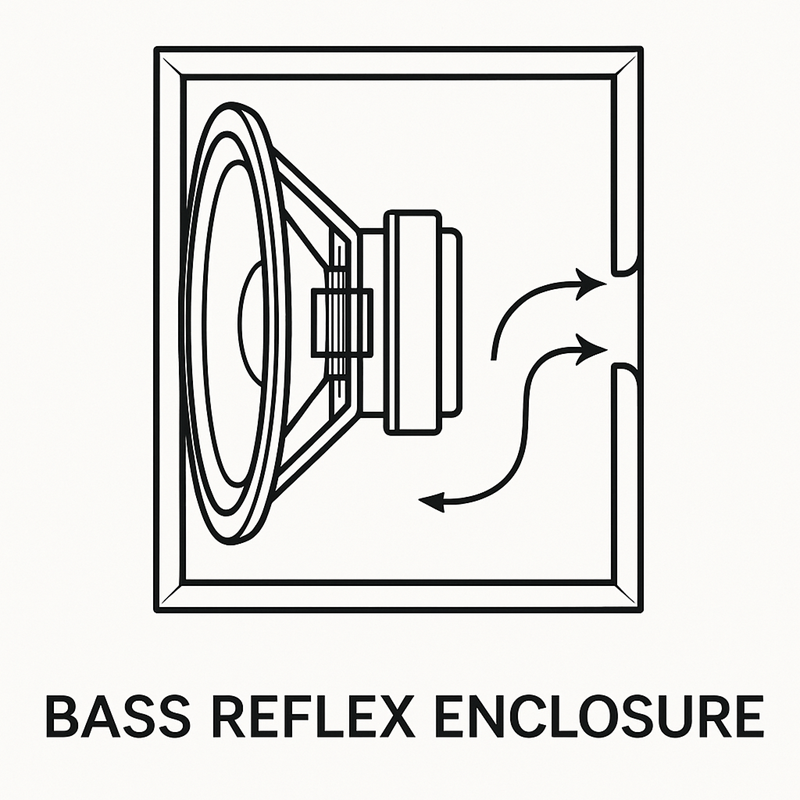
4.2 Bass reflex enclosure (ported enclosure)
This type was introduced in 1930 by Thuras. The cabinet has a port opening on a panel. Many ports include a tube. The cabinet volume and port size form a resonance based on the Helmholtz principle. The back wave of the speaker is inverted by the port and then added to the front wave in phase.
A ported box has wider bandwidth, higher efficiency, and lower distortion if designed well. The low-frequency limit can be about 20% lower than the driver’s own resonance. This type can make strong bass even with a smaller cabinet and is the most common design today.
4.3 Resistive port enclosure
This is a special version of a ported box. Absorption material is placed inside the port tube. It works like a semi-sealed box. It slows the flow and lowers the tuning frequency, making the bass range wider.

4.4 Transmission line enclosure
This type is based on transmission line theory. Behind the driver there is a long tube made with sound-absorbing walls. The tube length is often 1/4 or 1/8 of the target low-frequency wavelength.
The goal is to absorb the back wave so it does not reflect back to the opening. In real use, it also adds damping and tuning effect, increases output near resonance, and reduces cone movement. The internal path is often folded like a maze. So it is also called “labyrinth type”.

4.5 Passive radiator enclosure
This is a branch of the ported design. It was introduced in 1954 by Olson and Preston. The cabinet port is replaced by a cone without magnet and voice coil. The passive cone moves in phase with the main driver. The air in the box and passive cone form a resonance system that boosts low bass.
This design removes port noise and keeps output stable. Even a small box can get good bass and high efficiency. Standing waves are lower, so the sound is clear and clean.

4.6 Coupled cavity enclosure
This design sits between sealed and ported structures. It was introduced in 1953 by Henry Lang. One side of the cone drives the output port. The other side is connected to a sealed chamber.
This increases air movement at low frequencies. The coupled chamber is a tuned system. When the cone movement is limited, the port output will not exceed the cone output. It expands low-frequency range, lowers distortion, and increases power handling. The Lo-D A.S.W (Acoustic Super Woofer) in 1969 is a classic example. It allows small long-stroke drivers to produce deep bass with low distortion.

4.7 Horn enclosure
Home designs often use folded horns to save space. A horn uses a flare shape to match the small cone area to a larger air load. This improves efficiency and increases output. It is not a branch of the ported design. It is a different loading method.
Common home horn types include:
·Front-loaded horn: the back side of the driver is sealed, and sound goes through the horn on the front.
·Back-loaded horn: the front side radiates direct sound, and the back side goes into the horn path and gets amplified.
There is no need for a port tunnel to balance pressure because the horn loading already does this. Horn speakers are very efficient and have low distortion. They can reach high sound pressure. But they are large in size. In many cases, horn systems can deliver better dynamic range than sealed or ported designs.

5. Conclusion
Speaker boxes may look simple, but internal structure changes sound in a big way.Sealed boxes sound clean. Bass reflex gives stronger bass with less power.Transmission line controls rear wave. Passive radiator helps boost low end even in small boxes.Each structure is a different way to manage air, pressure, and low-frequency output.
So when we choose or design speakers, we do not look at “appearance only”.We must look at:speaker unit type,cabinet structure,low-frequency goal,power handling.
This helps us get better bass, better clarity, and lower distortion — with the same input power.
6. FAQ
Q1: How does the speaker enclosure structure change the sound?
The enclosure controls how air moves inside the box.This air movement changes bass depth, speaker efficiency, and distortion level.So even with the same speaker driver, two box designs can sound very different.
Q2: What is the main advantage of a sealed (closed) box?
A sealed box traps air inside.This air works like a spring.It keeps the cone movement under good control.So sealed boxes produce tight, accurate bass, but not very high bass output.
Q3: Why is a bass reflex (ported) speaker more common?
A bass reflex box has a port tube that boosts low frequency output using air resonance.So we get stronger bass from a smaller cabinet, and less amplifier power is needed.
Q4: How is a passive radiator box different from a ported box?
A port uses air only.A passive radiator uses a cone without magnet and voice coil to move air.
Q5: Why is transmission line design considered complex?
Inside the cabinet there is a long folded path like a maze.This path slows and absorbs the rear wave from the cone.This reduces standing waves, extends low frequency, and makes bass more stable.
Q6: What makes a horn speaker special?
A horn uses a flared tube to match speaker cone pressure to air pressure.This greatly boosts efficiency and SPL.This is why horn speakers are used in PA systems, stadiums, and outdoor spaces.
Q7: What is the role of a crossover in a speaker?
Different drivers are good at different frequencies.The crossover sends high frequencies to the tweeter, mid to midrange, and low to woofer.


 AR
AR
 EN
EN


