Cookies Setting
We use cookies to improve your browsing experience, analyze traffic, and personalize content. By using this site, you agree to our use of cookies. For more details, please check our Cookie Policy.
Home News

Types of Speakers: Full-Range, Crossover, Subwoofer & More

Types of Speakers: Full-Range, Crossover, Subwoofer & More
2026-03-06 Author: Aaron Page view: 394
In audio systems, we often hear about full-range speakers, subwoofers, etc. These speakers may sound familiar yet unfamiliar. This article briefly introduces the definitions, advantages, disadvantages, and selection methods of these speakers to provide some reference when designing or purchasing speakers.

Table of Contents

Speaker Classification

What is a Full-Range Speaker?

The range of sound audible to the human ear is 20Hz to 20kHz, sounds exceed this range are classified as ultrasound, we can’t hear them.As is well known, the frequency range of 20Hz to 20kHz is usually divided into three parts: high frequency, mid frequency, and low frequency, with these basics in mind, let's look at the definition of a full-range speaker.A full-range speaker is actually a wide-range speaker, meaning a single speaker can cover most of the audio frequency range, because there is currently no speakers in the world can achieve a full frequency range. Of course, full-range speakers also vary in quality. Low-end full-range speakers may only cover the 150Hz to 15kHz frequency range, while mid-range and high-end full-range speakers can cover 80Hz to 18kHz or even wider, but the price will also be higher.

What is a crossover speaker?

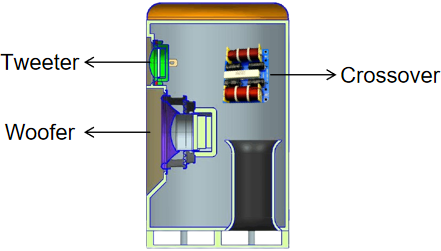
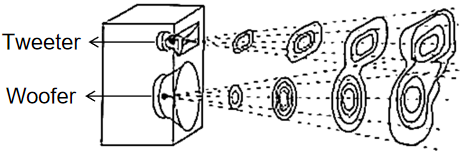
A crossover speaker, as the name suggests, it is capable of dividing sound into different frequency bands, and then send them to different speakers, for example tweeters, mid-range drivers and woofers for playback, generally, sound can be divided into two or three frequency bands, two frequency bands is corresponding to two-way speaker, three frequency bands is corresponding to three-way speaker, the internal structure and sound production principle diagram of a two-way speaker(Crossover speaker) are shown below:


In an audio system, a tweeter is a speaker unit, not a complete speaker, it has to work together with mid-range unit and woofer unit, the tweeter is specifically used for playback of high frequency sounds(Usually 2kHz~20kHz), the size of a tweeter is usually small, however, it can enhance the clarity, brightness, and transparency of sounds.

What is a tweeter?

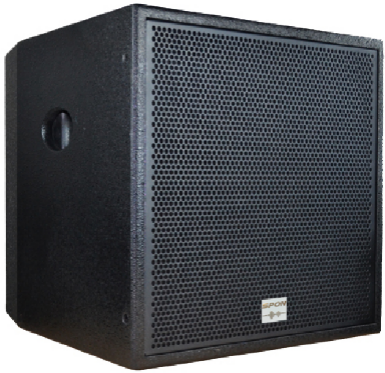
In an audio system, a low frequency speaker can be a speaker unit inside a crossover speaker or a standalone complete speaker, we need to determine which category it belongs to based on the context, if it is described as a speaker unit, it is a component inside a crossover speaker, if it is described as a subwoofer, it is a standalone complete speaker. no matter what category it belongs to, they have the same function, that is reproducing of the low-frequency of sound (Usually 20Hz~200Hz), usually, the size of a low frequency speaker is big, so that it can push a large amount of air for obtaining deep, powerful, and dynamic low-frequency reproduction.

What is a subwoofer?

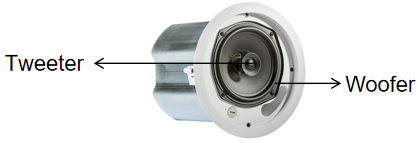
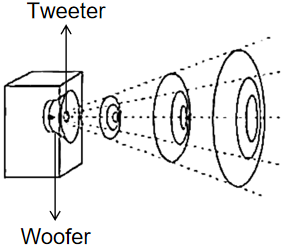
A coaxial speaker has its mid-bass and tweeter units deployed on the same axis, appearing as two concentric circles from the front, hence the name coaxial speaker. A coaxial speaker is not a full-range speaker; it is a special type of crossover speaker that looks like a full-range speaker, the deployment of tweeter and woofer units in a coaxial speaker and sound production principle diagram of a coaxial speaker are as follows:

What is a coaxial speaker? 

A coaxial speaker has its mid-bass and tweeter units deployed on the same axis, appearing as two concentric circles from the front, hence the name coaxial speaker. A coaxial speaker is not a full-range speaker; it is a special type of crossover speaker that looks like a full-range speaker, the deployment of tweeter and woofer units in a coaxial speaker and sound production principle diagram of a coaxial speaker are as follows:

Features of Various Speakers

After knowing the definitions of above speakers, now, let's summarize their main features:
  Full-Range Speaker Crossover Speaker Tweeter Subwoofer Coaxial Speaker
Structure Simple Complex As part of a speaker enclosure, its structure is simple Simple Relatively complex
Cost Low Relatively High / High Relatively High
Phase Difference None Usually Yes Usually Yes Usually Yes None
Number of Speaker Units 1 pc Generally 2 or 3 pcs / Generally 1 or 2 pcs 2 pcs
Sound Effects Advantages: Good sound continuity, no frequency band gaps, excellent mid-range performance; Disadvantages: Limited low and high frequency extension, difficulty in reproducing high-frequency details and powerful bass effects, prone to distortion at high power output; Advantages: Detailed frequency band division, accurate sound reproduction, strong sense of layering, wide frequency response range, able to balance high and low frequency details and powerful bass effects. Advantages: Improves overall sound clarity and transparency. Disadvantages: Can only reproduce high frequencies, cannot be used independently, and is sensitive to installation location. Advantages: Enhances sound immersion and atmosphere. Disadvantages: Big size, heavy weight, higher cost, and prone to low-frequency muddiness. Advantages: No phase difference, simpler structure than ordinary crossover speakers.

How to Choose the Right Speakers?

The principle of choosing speakers is to "fit the usage scenario and match your own needs", choosing the right one is the best. Here are two simple ways to choose speakers for your reference:

Choose according to purpose

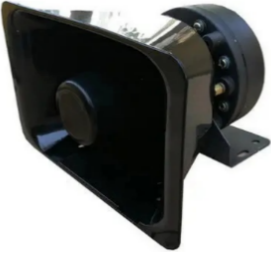
(1) For speaking, broadcasting, and background music, with a low budget and clear sound, choose a full-range speaker.(2) For standard meetings where speaking is clear and the music effect is good, choose a coaxial speaker.(3) For high-end meetings where the sound is clear, the positioning is accurate, and the listening experience is natural, choose a two-way speaker.(4) For long distances and large spaces where clear sound is essential, choose a tweeter horn speaker.(5) For a powerful and atmospheric experience, add a subwoofer.

Choose according to budget

(1) Low budget, choose a full-range speaker(2) Medium budget, choose a coaxial speaker (3) High budget, for better sound, choose a two-way speaker(4) For long-distance outdoor transmission, choose a tweeter horn(5) For creating ambiance, add a subwoofer

Summary

This article briefly introduces the definitions, features, and selection suggestions of speakers. The core differences between various types of speakers lie in "frequency range coverage" and "structural design." There is no absolute good or bad, only whether it suits your needs.
FAQS
Q1: What is the purpose of a subwoofer?
Subwoofers are designed to reproduce low-frequency sounds. In professional sound reinforcement scenarios, subwoofers are mainly used to enhance the atmosphere of the venue. Without subwoofers, the sound lacks power and can’t create an exciting atmosphere.
Q2: What are tweeters used for?
Tweeters are primarily designed to reproduce high-frequency sounds, which the human ear is most sensitive to. Tweeters make vocals clearer and music sound more delicate, bright, and transparent.
Q3: What is the difference between coaxial and normal speakers?
Coaxial speakers come with both high and low frequency drivers mounted on the same axis, eliminating phase difference. They are usually more expensive than normal full-range speakers and have only one speaker unit hole, normal full-range speakers have one speaker unit hole, while normal crossover speakers have two or three speaker unit holes.