


 2024-11-12
 Author: SPON COMM
 Page view: 14310
Classification by Function and Nature into Three Types
Business Public Address System:
Installed in office buildings, commercial towers, schools, hospitals, railway stations, airports, banks, and factories, business PA systems are designed primarily to meet the needs of business and administrative management.
Service Public Address System:
Found in hotels, malls, entertainment facilities, and large public venues, service broadcasting provides background music and in-room broadcasts for an enjoyable audio experience. These broadcasts, typically set to four program channels, aim to provide pleasing music and other content based on the service level and audience.
Emergency Public Address System:
Primarily used during fire incidents, the emergency PA system allows fire personnel in the control room to guide people to evacuate dangerous areas quickly.
Analog Public Address System Topology Diagram

By Transmission and Signal Processing Method
This system transmits analog power signals through audio lines directly to terminal speakers. It uses high-level transmission from the equipment room's power amplifier to the speakers, typically at 100V or 70V. The advantages include low line loss and convenient load connection, as speakers with step-down transformers can simply be connected in parallel to the line.
Network Public Address System:
In this setup, audio signals are digitized and transmitted, recorded, replayed, and otherwise processed in digital form. Digital audio technology presents audio signals as binary (0, 1) data, offering a higher signal-to-noise ratio (S/N), lower distortion, and a broader dynamic range, advantages that analog audio cannot match.
Topology Diagram of a Network Public Address System

Key Points in Public Address System Design
1、Selection of Transmission Structure
For small areas, single buildings like office buildings with fewer broadcast zones and more centralized layouts, a constant voltage wired transmission method (analog broadcast) is typically used.
For larger, combined building complexes with multiple broadcast zones and dispersed points, where different areas have different audio source requirements, it is recommended to use a hybrid approach with analog transmission at the front end and network transmission at the backend (analog + digital broadcast).
Schools, due to the need for hearing exams, often adopt a dual system with both digital and analog backup.
2、Selection of Constant Voltage and Constant Resistance

When the transmission distance is longer, constant voltage output should be used. The output voltage for the constant voltage feed lines should be 70V or 100V.
In a wired PA system, the line attenuation from the output of the amplifier equipment to the most distant user speaker should meet the following requirements (specifications):
1) For business broadcasting, the attenuation should not exceed 2dB at 1000Hz.
2) For service broadcasting, the attenuation should not exceed 1dB at 1000Hz.
3、Cable Laying Methods

4、How to pick speaker power for different scenarios?
1) For offices, living rooms, guest rooms, etc., speakers with a power rating of 1–2W can be used.
2) For corridors, hallways, and public areas with background music or business broadcasts, speakers should have a power rating of 3–6W.
3) The sound pressure level of the speakers should be 10–15dB higher than the ambient noise level.
4) Speakers installed in corridors, lobbies, restaurants, and other public areas should have a rated power of at least 3W.
5) The rated power of speakers in guest rooms should be no less than 1W.
6) In areas with background noise interference, such as air conditioning rooms, ventilation rooms, laundry rooms, entertainment areas, and garages, the sound pressure level of the farthest point within the speaker's coverage should be at least 15dB higher than the background noise.
7) Speakers installed in bedside control cabinets should have fire alarm broadcast capabilities.
8) When using a radio frequency transmission centralized sound system, the speakers in the bedside control cabinet should have the ability to broadcast emergency fire alarm signals. If the bedside control cabinet does not have this feature, the speakers installed in the hallway outside the guest room should have an input power of no less than 3W, and the spacing between the speakers in the hallway should not exceed 10m.
9) In civil buildings, speakers should be installed in public areas such as corridors and lobbies. The rated power of each speaker should not be less than 3W, and in locations where the ambient noise level exceeds 60dB, the sound pressure level at the farthest point in its coverage should be at least 15dB higher than the background noise.
10) In underground parking lots, fire stairways, and rooms without ceilings, speakers with a power rating of 6W (wall-mounted) should be used.
11) In outdoor public spaces such as roadsides, grass fields, and gardens, speakers with a power rating between 15–30W, such as grassland speakers or outdoor sound columns, should be used.
5、Types of speakers, their features, and applications
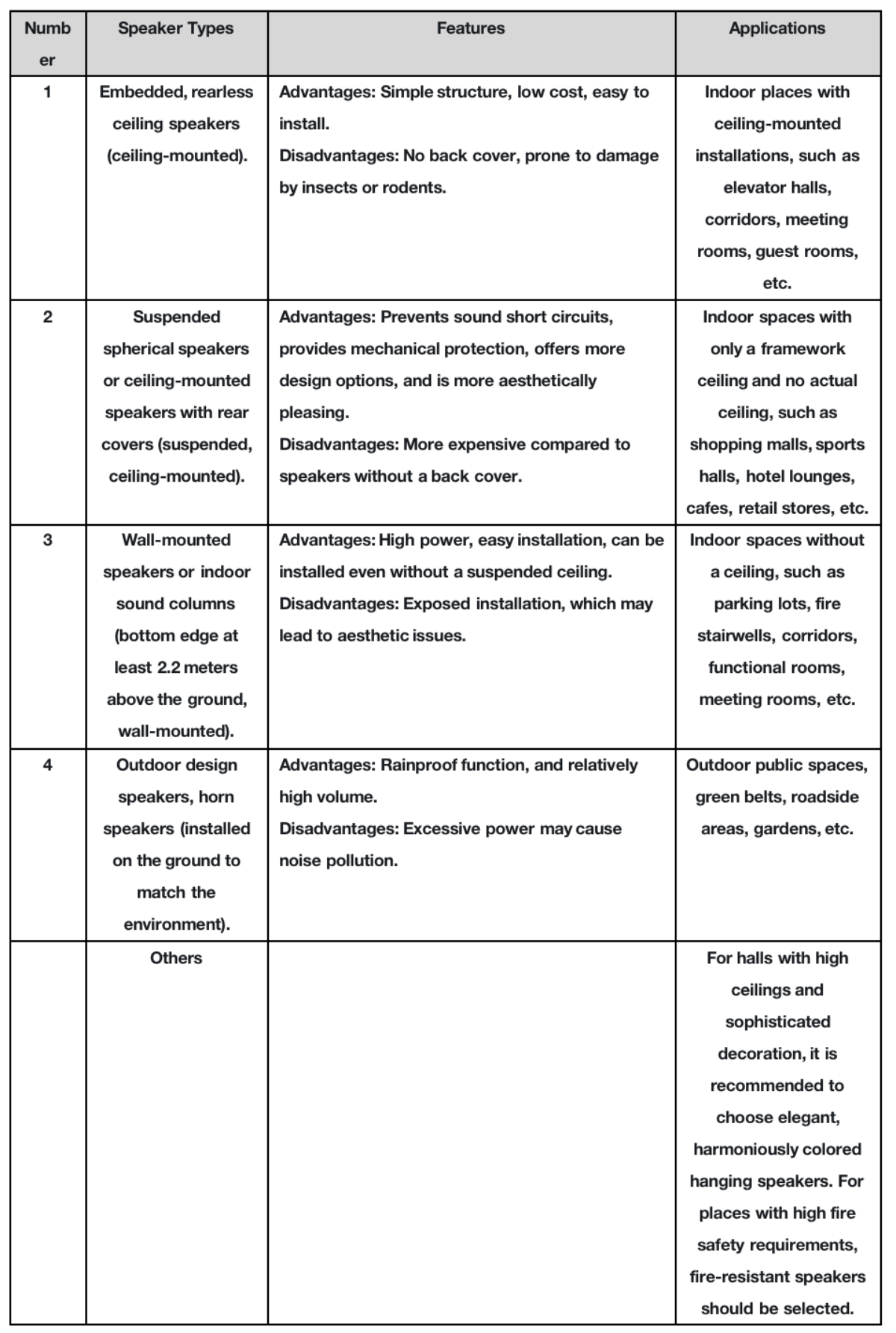
6、How to design and calculate the distance between speakers
In any fire protection zone, the distance from any point to the nearest speaker should not exceed 25 meters. The distance from the last speaker in a corridor to the end of the corridor should not exceed 12.5 meters.
1. For speaker spacing in lobbies, elevator halls, and lounges:
Use the following formula for estimation:
\( L = (2 ~ 2.5) \times H \)
where:
\( L \) = speaker spacing (m)
\( H \) = speaker installation height (m).
2. For speaker spacing in corridors:
Use the following formula for estimation:
\( L = (3 ~ 3.5) \times H \)
3. For speaker spacing in conference halls, multifunctional halls, and dining rooms:
Use the following formula for estimation:
\( L = 2 \times (H - 1.3) \times \frac{LgQ}{2} \)
where:
\( Q \) = the radiation angle of the speaker, typically required to be greater than or equal to 90°.
For places where the ceiling is no higher than 3 meters, speakers (3W, 6W) should be evenly spaced 8-12 meters apart.
Outdoor speakers (15W, 20W) should be spaced approximately 30 meters apart, and it is advisable to avoid placing them directly under users' windows. Emergency broadcasts should be designed according to fire safety regulations, with point layout diagrams typically provided by fire professionals.
7、How to choose and calculate Power Amplifier?

The rated output power of the amplifier should be chosen based on the total power of the broadcast speakers, line losses, aging, product quality, and other factors, with an appropriate power margin. The general calculation is as follows:
P = K1 * K2 * ∑P0
Where:
- P is the total output power of the amplifier (W)
- P0 is the maximum electrical power for simultaneous broadcast in each zone (W).
- P0 = Ki * Pi
- Pi: Rated capacity of user equipment in the i-th branch (W)
- Ki: Simultaneous requirement coefficient for the i-th branch
- Service broadcast guestroom programs: 0.2 – 0.4
- Background music system: 0.5 – 0.6
- Business broadcast: 0.7 – 0.8
- Fire emergency broadcast: 1.0
- K1: Line loss compensation coefficient (1.26 – 1.58)
- K2: Aging system factor (1.2 – 1.4)
1) The rated output power of the amplifier for background music broadcast should be approximately 1.3 times the total power of the broadcast speakers.
2) The rated output power of the amplifier for emergency broadcasts should be 1.5 times the total capacity of the broadcast speakers.
3) The backup amplifier should be 1.5 times the total power of the largest three zones combined.
8、The principles for dividing broadcast zones
1) User requirements (categories);
2) Broadcast control (for easy management);
3) Broadcast line routing;
4) Emergency broadcasts should meet fire safety compartmentalization, which can correspond one-to-one or exceed the number of fire compartments.
9、System Power Supply
1) The AC power supply level should be adapted to the building's power supply level. For important broadcast systems, two power supplies are required, with automatic switching at the distribution box at the end.
2) The voltage deviation of the AC power supply should generally not exceed 10%. If the voltage deviation cannot meet the equipment's limit requirements, an automatic voltage stabilizer should be installed, with a power rating not less than 1.5 times the required power.
3) The broadcast system should have a dedicated power supply line. When the power amplifier capacity is 250W or higher, a power distribution box should be installed in the broadcast and amplification control room. The power amplifier cabinet of the broadcast and amplification equipment should be powered by a single-phase three-wire system in a radial configuration.
4) The AC power supply capacity for the broadcast system is generally 1.5 to 2 times the capacity of the final broadcast equipment.
Experience: When estimating the power capacity required for a broadcast system, the signal source, pre-stage, and control equipment can generally be disregarded. The total power for the system can be calculated by multiplying the total power of the power amplifiers by 3:
P = 3 * Pi * N
Where:
P — Total system power
Pi — Rated power of a single power amplifier
N — Total number of power amplifiers in the system (excluding spare units)


 AR
AR
 EN
EN


