


 2025-10-17
 Author: cora
 Page view: 7412
Signal-to-noise(SNR) is an important concept in the audio field. It’s a key measure of how clear sound is and often helps decide how good the final audio sounds. Understanding sound quality can be a bit tricky, especially when technical terms like sensitivity and signal-to-noise ratio are involved. Whether you’re an audio beginner, a music lover, or just curious about how sound works, this article will give you a simple and clear overview. We’ll explain what SNR means, why it matters, and how it affects the way you hear sound. By the end, you’ll understand how SNR shapes overall sound quality and how to use it to get better audio.
What is SNR
Signal-to-Noise Ratio, or SNR, is a way to compare the strength of the wanted audio signal to the level of background noise. In simple terms, it shows how loud the main sound is compared to any unwanted noise. It’s measured in decibels (dB), and a higher SNR means the sound is clearer and of better quality. In short, SNR measures how clean the sound is, helping people judge audio quality in a clear way. The example from Wikipedia below shows how SNR is similar to how sharp or clear an image looks.

The idea of SNR is based on the simple goal of separating useful sound from outside noise. It’s an important measure in many areas, such as recording studios, live sound systems, and broadcasting. A high SNR usually means professional-level audio quality, where the main sound is clean and not affected by hiss, hum, or buzz. Understanding SNR is more than just looking at numbers — it’s key to making sure the sound you want to hear comes through clearly without noise or distortion.
Why SNR Matters
In the realm of audio, clarity is paramount. Whether you're listening to music, watching movies, or broadcasting using speakers and microphones, you want the primary audio signal to be as clear as possible. A high signal-to-noise ratio (SNR) ensures the desired audio is significantly louder than background noise, delivering a more enjoyable listening experience. It not only provides clearer sound but also allows you to appreciate the full spectrum of audio—from the subtleties of a musical piece to the intricate details of a film score.
In environments where precision and clarity are paramount—such as professional audio production and critical listening settings—SNR becomes especially vital. In these scenarios, even minimal noise can degrade the listening experience, making maximizing SNR essential. Furthermore, in everyday scenarios like intercom calls or video conferences, a high SNR reduces misunderstandings caused by background noise, thereby improving communication efficiency. Prioritizing SNR thus enhances the functionality of audio applications.
Components of SNR
Audio Signal
The audio signal is the sound you want to hear. It could be your favorite song, a podcast, dialogue in a movie, a broadcast from a speaker, or participants speaking in a conference system. The strength and quality of the audio signal determine how well it stands out in noisy environments. A high-quality audio signal is characterized by clear, undistorted sound that accurately conveys the intended message or emotion.
Technically speaking, the audio signal encompasses the entire frequency and amplitude range that constitutes sound. Capturing a robust audio signal requires precision recording equipment and techniques to ensure fidelity and clarity. Furthermore, maintaining a strong audio signal throughout the production process—whether recording, mixing, or broadcasting—is crucial for preserving the integrity of the sound.
Background Noise
Background noise refers to any unwanted sound interfering with the audio signal. Examples include the hum of air conditioners, static noise from audio equipment, or ambient sounds in the recording environment. Reducing background noise is vital for achieving a high signal-to-noise ratio. Techniques such as soundproofing, using noise gates, and employing directional microphones can help minimize these disturbances.
The impact of background noise extends far beyond auditory distraction; it also alters people's perception and emotional response to audio content. For instance, in music production, unwanted noise distracts listeners from appreciating the artistic nuances of a piece. In communication systems, excessive background noise leads to misunderstandings and listener fatigue. Therefore, controlling and reducing background noise is key to achieving high-quality audio.
Dynamic Range
Dynamic range refers to the difference between the quietest and loudest parts of an audio signal. A wider dynamic range enables richer expressiveness in audio but requires careful management to maintain a good signal-to-noise ratio (SNR). With ample dynamic range, audio can fully convey the emotional depth and technical nuance of a performance—from the softest whisper to the loudest crescendo.
Managing dynamic range involves balancing sonic expressiveness with clarity. Compressors and limiters are common tools in audio production for dynamic range management, ensuring quieter sounds remain audible while preventing distortion in louder passages. Effective dynamic range management not only enhances the signal-to-noise ratio but also ensures audio maintains impact and clear intelligibility across any listening environment.
Measuring Audio Signal-to-Noise Ratio
SNR is calculated using the following formula:

This formula helps quantify the strength of an audio signal relative to background noise.
By measuring the power levels of both the signal and the noise, the Signal-to-Noise Ratio (SNR) provides a clear numerical representation of audio quality.
For audio engineers who focus on optimizing sound systems and recording clarity, this calculation is essential.
Understanding the mathematical foundation of SNR allows professionals to make informed decisions when designing and setting up audio equipment.
They can also use SNR measurements to identify which noise reduction methods improve overall sound quality, troubleshoot performance issues, and fine-tune their audio systems.
By continuously measuring and monitoring the SNR, engineers ensure their setups meet industry standards and deliver an excellent listening experience.
1.High SNR (above 50 dB)
Indicates excellent sound quality with minimal background noise.
This level of SNR is typical in professional audio environments where clarity and precision are critical, such as studios and broadcast systems.
2.Medium SNR (30–50 dB)
Represents acceptable audio quality for most applications.
This range is common in consumer electronics, conference systems, and general listening environments.
3.Low SNR (below 30 dB)
Suggests poor sound quality with noticeable background noise.
At this level, the audio may be difficult to understand or enjoy, especially in noisy surroundings.

Picture from Izotope
Why SNR Matters in Communication Systems
In any system that processes or transmits signals — such as telecommunication networks, audio devices, radar systems, imaging systems, and data acquisition systems — SNR plays a decisive role.
• When SNR is high, communication is stable and reliable.
• When SNR drops, signal distortion increases, leading to errors, poor audio quality, or lost data packets.
For example:
A. In phone calls or VoIP, high SNR ensures natural, noise-free speech.
B. In video conferencing, it helps maintain clear voice and smooth image.
C. In data transmission, it reduces bit error rate and improves efficiency.
How to Improve SNR
Improving SNR is essential for ensuring clear and reliable signal transmission.Here are several effective methods used in communication systems:
1. Increase Signal Strength:Boosting the transmitted power or using amplifiers helps strengthen the desired signal.
2. Reduce Noise Level:Use shielding, grounding, and low-noise components to minimize interference.
3. Apply Signal Filtering:Filters remove unwanted frequency bands and suppress background noise.
4. Use Error Correction Techniques:Modern coding algorithms detect and correct transmission errors automatically.
By combining these hardware and software techniques, communication systems can achieve a significantly higher signal-to-noise ratio.
The Relationship Between SNR and Data Transmission
SNR not only affects sound clarity or image quality — it also determines how much data can be reliably transmitted through a communication channel.
According to the Shannon–Hartley theorem, the channel capacity C is given by:
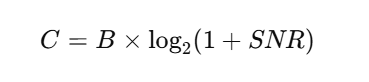
Where:
C: Maximum data rate (in bits per second)
B: Channel bandwidth (in hertz)
SNR: Signal-to-noise ratio
This means that higher SNR allows more data to be transmitted without errors, which is vital for high-speed internet, 5G, and modern digital communication systems.
Applications of SNR in Telecommunications
In the telecommunication industry, clear and stable transmission is essential.
High SNR ensures that signals remain accurate and free from interference, resulting in:
1. Clearer voice communication with minimal distortion
2. Stable video conferencing without lag or dropouts
3. Reliable data exchange across wired and wireless networks
Telecom operators, network equipment manufacturers, and communication engineers all work to maintain high SNR for the best user experience.
Modern Technologies That Enhance SNR
Today’s communication systems integrate advanced technologies to maintain high signal-to-noise ratios even in noisy environments:
1. Noise-canceling microphones and array microphone systems
2. Digital Signal Processing (DSP) and adaptive filtering
3. MIMO (Multiple-Input Multiple-Output) and channel coding technologies
These innovations enable clear, efficient, and stable communication — whether in mobile networks, smart conferencing systems, or public address installations.
Conclusion
SNR is one of the core performance metrics for communication systems. A high SNR translates to higher transmission rates, lower error rates, and clearer voice and image quality. Through signal enhancement, noise control, and intelligent algorithm optimization, modern communication systems deliver high-quality, low-interference communication experiences to users.


 AR
AR
 EN
EN


