

 2026-07-27
 Author: Aaron
 Page view: 5375
IP Public Address System is a digital communication system based on network communication protocol (TCP/IP) to transmit audio information to listeners in a wide area, It has 3 main functional applications: background music, business broadcasting, and emergency broadcasting.
The composition of IP PA system
The IP PA system is mainly composed of sound source, controller, transmission line, power amplifier, and loudspeaker.

1. Sound source
Wired or wireless microphone, CD/DVD player, digital audio workstation, network streaming media, etc., for providing audio input.
2. Controller
The "brain" of the system, responsible for signal processing and distribution.
3. Transmission line
Transmit the processed audio signals from the control device to speakers, there are usually two ways: 100V/70V Constant-voltage transmission and network transmission.
4. Power amplifier
Amplify low-level audio signals to drive the speakers.
5. Loudspeaker
Convert electrical signals into sound to cover the target area.
Design of IP PA system for small & medium-sized project
When designing an IP PA system, there are generally 3 scenarios: a pure IP system, an IP amplifier + analog speaker, and upgrading an existing analog system to an IP system. Let's examine each of these 3 scenarios:
1. Pure IP Solution
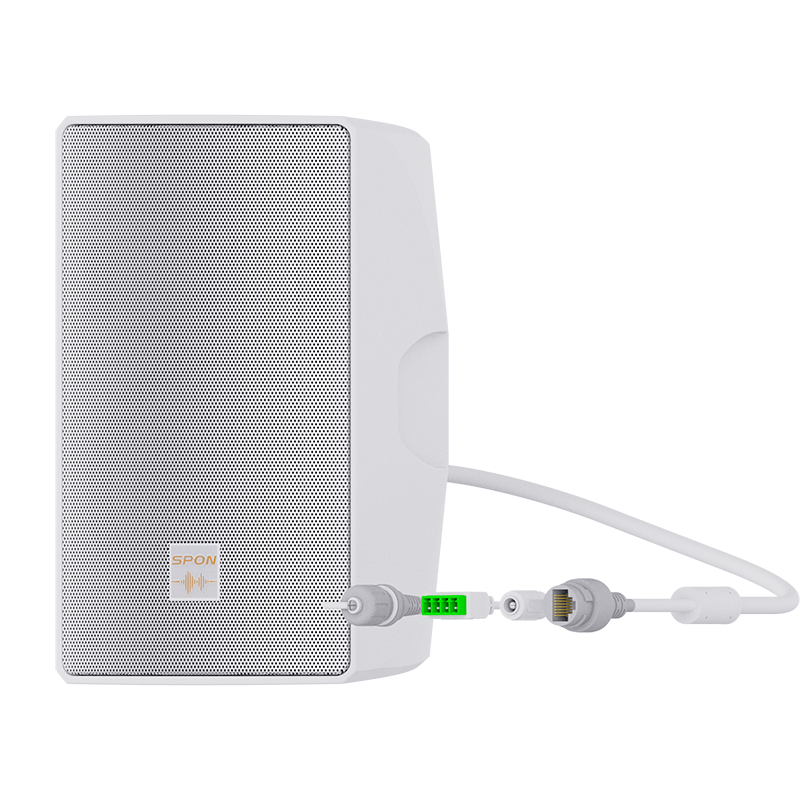
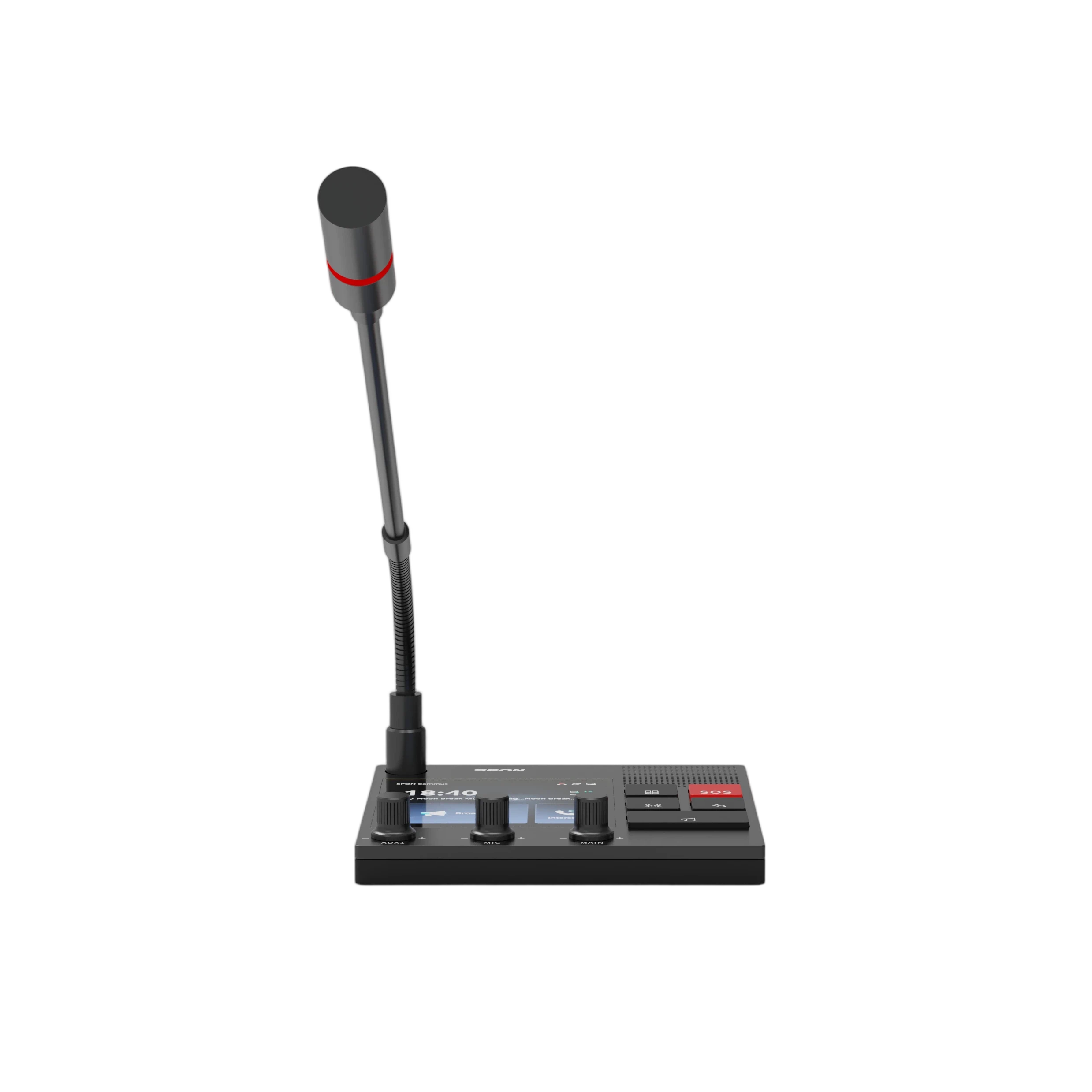
The Network Paging Console comes with a built-in server, suitable for managing in project with less than 30 IP terminals. Therefore, for small projects, a network paging console is enough for management. As for the front-end speakers, you can choose different types of speakers according to the on-site environment, such as network ceiling speakers, network wall speakers, and network horn speakers.

The network paging console has powerful audio access capabilities, which can broadcast external audio sources such as DVD, mobile phone, Bluetooth, U-disk etc. to the on-site speakers through the network.
2. IP Amplifier + Analog Speaker Solution
We can also use IP amplifier to drive on-site analog speakers according to the actual needs of the project.

How to choose the type of IP amplifier?
How to choose the rated power of IP amplifier?
Rated power of IP Amplifier should be equal to or more than 1.5 times the sum of rated power of all speakers it drives. e.g. 50×6×1.5=450, So we choose the most suitable amplifier XC-9508P50 (500 watts)

How to choose the type of analog speakers?
In principle, different types of speakers should be chosen depending on the on-site installation environment, such as:

1. Ceiling speakers are suitable for indoor areas with suspended ceiling, installation is beautiful.
2. Wall-mounted cabinet speakers or low-power column loudspeakers are suitable for indoor areas without suspended ceilings.
3. High-power waterproof column loudspeakers are suitable for outdoor areas.
4. Horn speakers are suitable for empty outdoor environment.
5. Lawn speakers are suitable for grassland and gardens, blend into the environment.
Notes: The conclusion above is suitable for most applications, but it is not absolute, please design specifically according to the project situation.
How to arrange analog speakers?
Note: The below form is the data obtained by achieving the SPL under normal ideal environment. For specific environments, please refer to the ambient noise on site for details. For example, even if it is the same speaker model, the distance between the speakers arranged in the corridor of office is different from that arranged in shopping malls. The distance in places with high noise should be appropriately closer, and the distance in places with low noise can be arranged according to the maximum value.

How to choose the cable diameter for connecting analog speakers?
Solution 1: Calculate the cable diameter for connecting analog speakers using the following formula
S ≈ 5 LP
S: Cross-sectional area of speaker cable, Unit is mm2;
L: Transmission distance, The distance between the farthest speaker and the amplifier, Unit is km;
P: The sum of the rated power of all loudspeakers, Unit is kW;
e.g., The sum of the rated power of all loudspeakers is 500W, and the farthest speaker is 1000 meters away from the amplifier, what should the cross-sectional area of the speaker cable be?
S ≈ 5 LP=5×1×0.5=2.5mm2
Note:
The conditions for using the above formula are as follows:
1. Adopting oxygen-free copper conductor for Speaker Cable ;
2. Adopting 100V constant voltage output;
3. Broadcasting line load is uniform (power distribution is uniform);
4. The line allows transmission loss of 3dB.
Solution 2: Select the cable diameter for connecting analog speakers according to the following comparison table.
Note:
1. The distance between the constant amplifier (100V) and the farthest speaker cannot exceed 1000m. The longer the distance, the greater the signal attenuation.
2. The method of the cross-sectional area of the speaker cable above is for reference only, In principle, the thicker the wire, the better.
3. The cable for outdoor transmission should be about 1 mm2 thicker than the cable for indoor transmission. e.g., for 1500W and a length of 100m, the wire of indoor transmission should be RVV2*1.5 and the wire of outdoor transmission should be RVV2*2.5.

3. Upgrading an existing analog system
The network audio bridge (GEN-3101A01) can decode network data packets and output analog audio signals. Therefore, for projects that already have an analog PA system installed, we can use network audio bridge to upgrade the analog PA system and make it IP-based. At the same time, we can also reuse the existing analog power amplifiers and speakers, saving system renovation costs.

How to choose the type of network decoder?
Conclusion
In this article, we introduced the main components of an IP PA system and explained how to choose the right amplifier and speakers, as well as how to calculate cable requirements during installation. We also discussed different setups, including pure IP systems, analog speakers with IP amplifiers, and upgrading traditional analog systems to IP-based solutions.
We hope this guide helps you better understand how to design and build an IP PA system that fits your project needs. If you have any questions, feel free to contact us — the SPON technical team is always ready to help.


 AR
AR
 EN
EN