


 2024-11-08
 Author: SPON COMM
 Page view: 1649
Overview
The SIPLink series is composed of various types of network audio terminals. This system can function as a standalone audio system or integrate with external systems and platforms (such as video surveillance platforms, internal communication systems, fire alarm systems, etc.) for coordinated operation and interaction.
The SIPLink series enables interaction with multiple different systems within the same project, offering flexible configurations that expand the possibilities for system integration in system design.

Key Nodes of Network Audio Transmission
The SIPLINK series can flexibly handle the below elements to meet the requirements of each project.

When: Determining Trigger Conditions
The timing of audio transmission is crucial and is triggered by specific conditions.
- Sensor / Alarm: When sensors detect activity or an alarm is triggered (e.g., security breach or emergency), it automatically initiates an audio alert or announcement.
- Timer: A pre-set timer can control scheduled announcements, like daily reminders, notifications, or announcements that broadcast at specific times.
- Manual Control: Authorized personnel can manually initiate audio broadcasts as needed, providing flexibility for real-time responses or unexpected situations.
What: Deciding Content for Transmission
Content transmitted over the network may vary based on the needs of the communication.
- Real-time Voice (Paging Microphone): Allows direct, live announcements through a microphone, suitable for paging individuals or broadcasting messages quickly across locations.
- Real-time Voice (SIP Phone): Using SIP phones, users can make live announcements or communicate across the network, ideal for urgent messages or one-to-one communication.
- Real-time Voice (VMS): Voice messages initiated via a Video Management System (VMS) integrate audio with video feeds for better situational awareness.
- Recording/Media Files: Pre-recorded messages or media files can be transmitted, providing consistent information for routine notifications or background music.
Where: Specifying the Broadcast Area
Audio transmission can be directed to different areas depending on the reach needed for effective communication.
- All-Call: Broadcasts to all terminals in the network, suitable for general announcements or emergency alerts affecting the entire location.
- Specific Area: Allows focused announcements for designated zones, such as notifying particular departments without disrupting others.
- Individual Terminal: Enables targeted messaging to a single device, useful for one-on-one communication or for reaching specific individuals.
How: Managing Conveyance of Audio Content
The methods for audio transmission ensure that content is delivered effectively and at optimal quality.
- Priority Management: Establishes a hierarchy for transmissions, allowing urgent messages to override routine broadcasts, ensuring critical information reaches the audience immediately.
- Volume Control: Allows volume adjustments based on location, time, or audience, so that messages are audible without causing disturbance or noise pollution.
SIPLink series products
The SIPLink series products are based on standard SIP, ONVIF audio, multicast audio, and HTTP command open interfaces, allowing the entire SIPLink series to be directly deployed in a network system and easily integrated into different systems such as VMS (Video Management Systems) or SIP phone systems.

SIPLink Series Products:
- These are a range of products (likely communication or audio devices) that support standard SIP (Session Initiation Protocol) for voice and video communication, and ONVIF (Open Network Video Interface Forum) for standardized network video products.
- SIPLink products are designed to work seamlessly in networking environments, offering compatibility with various systems that utilize these standards.
Standard SIP:
- SIP is a protocol used for managing multimedia communication sessions, such as voice and video calls over IP networks. It is a widely adopted standard for VoIP (Voice over IP) systems.
- By supporting SIP, the SIPLink products can easily integrate with any existing SIP-based systems, such as IP phones, VoIP gateways, or softphones.
ONVIF Audio:
- ONVIF is a global standard for IP-based security products, especially video surveillance equipment.
- Supporting ONVIF audio allows SIPLink products to integrate with ONVIF-compliant surveillance and security systems, facilitating seamless communication and audio integration in security networks.
Multicast Audio:
- Multicast refers to a method of sending data to multiple receivers at once, often used in broadcasting or streaming audio/video.
- The inclusion of multicast audio means SIPLink devices can send audio streams to multiple receivers simultaneously, which is useful in environments like public address systems or conference rooms.
HTTP Command Open Interface:
- An open interface using HTTP commands allows for remote control and configuration of SIPLink devices through standard HTTP requests. This makes the devices flexible and accessible from any device or platform that can send HTTP commands.
- This open interface can be used to integrate the SIPLink products into various systems without needing proprietary software or hardware.
Deployment and Integration:
- Because of their adherence to open standards like SIP, ONVIF, and multicast, SIPLink products can be directly deployed into existing network systems.
- Additionally, they can be easily integrated with VMS (Video Management Systems), which are used for managing video surveillance, or SIP phone systems, for voice communication.
Benefits
- Standard-Based Interoperability: By supporting common standards like SIP, ONVIF, and multicast, SIPLink products can integrate smoothly with a variety of devices and systems, avoiding proprietary lock-in.
- Ease of Deployment: The open interfaces and standard protocols make it straightforward to add SIPLink devices to existing network systems without extensive customization.
- Flexibility: The ability to integrate with both VMS and SIP-based phone systems allows SIPLink products to be used in diverse environments, such as security surveillance, communication systems, and other networked applications.
Example Use Cases
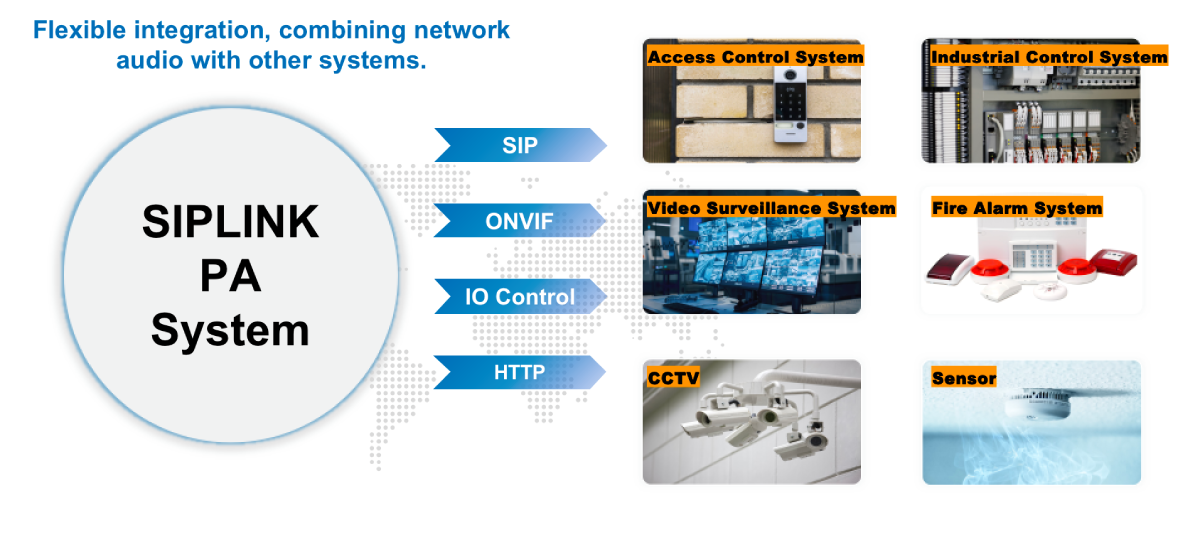
Security & Surveillance:
SIPLink products could be deployed in a networked security system to provide audio communication via SIP and multicast, integrating with a VMS for video surveillance and managing system configurations via HTTP commands.
VoIP/Telephony
SIPLink products can be part of a VoIP phone system, enabling high-quality audio communication over an IP network with easy integration into existing SIP-based infrastructure.
Multimedia/Conference Systems:
In environments like conference rooms, SIPLink products could multicast audio to multiple devices or integrate with SIP-based video conferencing solutions.
In Summary
The SIPLink series offers a versatile and open platform for integrating audio communication capabilities into various networked systems, ensuring compatibility with widely used standards like SIP, ONVIF, multicast, and HTTP, making it ideal for deployment in diverse environments such as video management systems, SIP phone systems, and more.


 AR
AR
 EN
EN


