


 2025-09-12
 Author: Tim
 Page view: 1680
For many years, educational facilities have depended on analog intercoms for primary communication. But there are so many limitations with these old systems, limitations that are even more noticeable in this day and age of education. Analog systems also tend to be less intelligent, with limited calling and paging capabilities. They are impractical because they depend on the use of point-to-point wiring, which results in difficult installation, expensive maintenance, and a virtually impossible means to expand the system. Not to mention that they cannot be combined with new security technologies such as CCTV or access control systems, which is a significant omission in any school’s security structure. Faced with rapidly evolving campus security concerns and the need for more intelligent operation and management, schools now need a single, intelligent platform that scales to meet their needs. This article will introduce and discuss the technical benefits and implementation use cases of IP (Internet Protocol) intercom systems, identifying it as the next step in campus communication and security.

Fundamental Structure of an IP Intercom System
The ideal combination of school intercoms today owes their power and flexibility to their IP-based design, which utilizes off-the-shelf networking concepts to provide advanced capabilities.
Keywords: IP Intercom System, Power over Ethernet (PoE), SIP Protocol
1. Server/Master Station:
A server or master station is the heart of the system as though it were the system's "brain." Usually a software application, the soft switch has the intelligence to disk all of the phones, to route calls, to capture user call log information, and to apply system configurations.
2. Network Connectivity:
The main benefit of IP-based intercom systems is that they can make use of the Local Area Network (LAN) or Wide Area Network (WAN) of a school. This eliminates the expensive and inconvenient dedicated over-the-air (OTA) cabling. The architecture heavily relies on Power over Ethernet (PoE), a solution that uses one Ethernet cable to deliver data and electric power to end devices, simplifying installation and reducing costs.
3. Terminal Devices (Endpoints):
The system has several specialized IP-based devices:
- IP Video Door Stations: Deployed at the entrance gate, dormitory, and office buildings, the door station offers two-way audio and video communications for performing visitor management.
- Indoor Stations: These units, which are fixed in various classrooms and offices, perform two-way audio/video communication and receive announcements for the entire campus.
- IP Paging Speakers/Horns: Used throughout areas such as hallways, gymnasiums, and fields to make campus-wide announcements and emergency notifications.
- SIP Phones: IP desks can be added, offering staff members a different type of interface to handle communication.
Integration Interfaces: Today’s IP systems are developed on open standards and provide APIs and SDKs. These interfaces are important to ensure that integration into other key campus systems, such as video surveillance (CCTV), access control, and fire alarm panels, can be smoothly facilitated.
Key Features & Application Scenarios
IP Intercom systems will become more than a communication device to a system, which also enables daily business as well as emergency situation solutions.
INTRODUCTION: Campus Communication Platform, Emergency Notification System (ENS)
1. Daily Operations & Management
- Automated Bell Scheduling: Admin can easily input complex bell schedules for regular school schedules, exams, or special events using a calendar-based visual interface.
- Multi-Zone Paging: The system is capable of delivering very specific messages. Alerts can be delivered campus or site-wide, to a building or group of buildings, a set of classrooms, or even to an individual room, consistent with context-sensitive transactions in other areas of risk management.
- Remote Access Control: When a guest at the door station rings the door, the office staff is alerted and able to visually identify the visitor on their video screen before allowing them access by using the remote unlock button to maintain perimeter security.
- Classroom to Office Communication: Teachers can call the principal from the classroom to help with any situation, including medical situations or disciplining students, without leaving the classroom. Inversely, the office can automatically call any classroom by themselves.
2. Campus Security and Emergency Response
- One-Touch Emergency Alarms: Akin to traditional “panic buttons,” hardware- or software-based instant triggers – either physical or on-screen buttons – that clear, removing the need to pre-set the alarm parameters, alert teachers and staff of an emergency (school lockdown, etc.) with the click of a button.
- Mass Notification: In times of emergency, the solution can transmit recorded or live audio and video to all spaces on campus, such as IP speakers, indoor station screens, and built-in digital signage – delivering crystal-clear instructions with rapid speed.
- Systems Integration & Automation: The real strength of an IP system is the capability to have responses automated through system integration:
- Integration with Fire Alarm System: The system can receive signals from the fire panel, automatically issue evacuation commands, and issue voice prompts respectively.
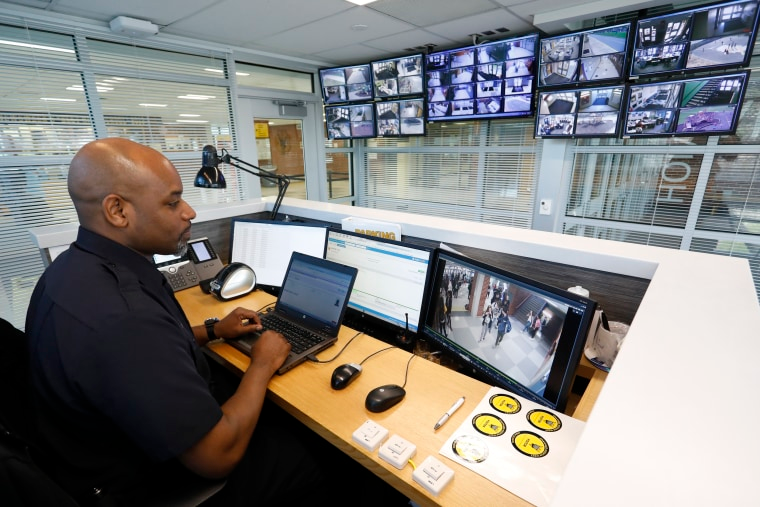
- Elektron Intercom Integration: When a call is made to the intercom, the system can automatically show a live image from a nearby CCTV camera on the operator's monitor to give instant visual context.
- Access Control Integration: Initiating a “lockdown” alert can simultaneously send a direct message to the access control system to lock down all specified exterior and interior doors to form a physical barrier immediately.
Deployment Advantages and Implementation Considerations
Advantages:
- Scalable: There is no need to pull new trunks back to a central point to add an extension.
- Flexibility: The fact of using network and infrastructure results in fast deployment - not dependent on the physical limitations of dedicated wiring.
- High integration: IP systems add value in that they break down silos of data by integrating security and communication into one platform.
- Low Maintenance: Diagnosis, setting, and updating of the systems can be done remotely via network connections, thus minimizing on-site freight and technician support.
- Feature Packed: Beyond what traditional analog systems can do, digital provides the benefits of high-definition sound, text messaging, and event logging.
Implementation Considerations:
- Network Testing: A comprehensive test of the current network is necessary to determine if enough bandwidth and stability is available to support real-time audio and video traffic without degradation.
- Cybersecurity: Since it is a network system, cybersecurity would be an issue as unauthorized access is a potential threat, and safeguards like setting up various LANs (VLANs) for security devices and also ensuring that data is encrypted to avoid leakage of information.
- Device Compatibility: You will want to pick a device that meets open standards (like the Session Initiation Protocol) to make it work and operate without proprietary restrictions.
- User Training: Every staff member who will use the system should be trained in both daily operation and emergency operation of the system to maximize its effectiveness when it's needed.

Conclusion
Today’s IP intercoms are more than a simple talk-back device. It’s now a powerful, software-based campus communication system with organized day-to-day control along with proactive security at every level. Because these systems can be designed to use a school's own network infrastructure, they provide scalability, flexibility, and integration beyond most other options. In the future, with the convergence of IP communication with IoT & AI, these systems will become smarter and smarter. Future platforms would offer predictive threat detection via sound and video automation, making them a crucial part of the intelligent, secure campus. A reliable, robust investment in a contemporary IP intercom system is an investment in the security and performance of any academic environment.


 AR
AR
 EN
EN


